14 April 2009
07 April 2009
weekly update: all in a day's work.
Yes indeedy, as Ryan pointed out last week, we have finished excavating our very first deposit from Project 23:

10B is no more! And its big sister 10A is soon to follow:

We're down to Project 21-and-a-half. The small patch of fossils from this deposit seems to have petered out. We can't be sure, but we're thinking the remaining few feet of dirt are largely -- if not entirely sterile. The boundaries between grids are left in place until they're completely exposed, and then mapped and photographed. This way, we can reconstruct the deposit's geology long after the deposit has been excavated.
And 5B looks much the same is it did last time I posted, only sans a level of plywood around the sides.

We're waiting to speak to one of the geologists who originally supervised the salvage before we begin digging.
Meanwhile, in Deposit 1....

We're still plugging away at the main bone jumble in Box 1. We've measured out at least another 100 fossils from this area. Right now, however, we're at a bit of a standstill, stuck between a rock and a hard place so to speak. Or rather, a scapula (shoulder blade) and an innominate (one half of a pelvis):

Pleistocene pick-up sticks once again! From left to right: we can't get the first innominate out without removing the scapula immediately above it, but we can't get that scapula out because of the saber cat vertebra immediately above it. THAT's stuck under the middle scapula, which is in turn pinned in place by next-to-last scapula, which is, of course, covered by both a cat humerus (lion or saber cat, not sure though) and yet another scapula.
This is all very detailed, very slow work. However, on the other side of Box 1, we get the other end of the paleo-work perspective:
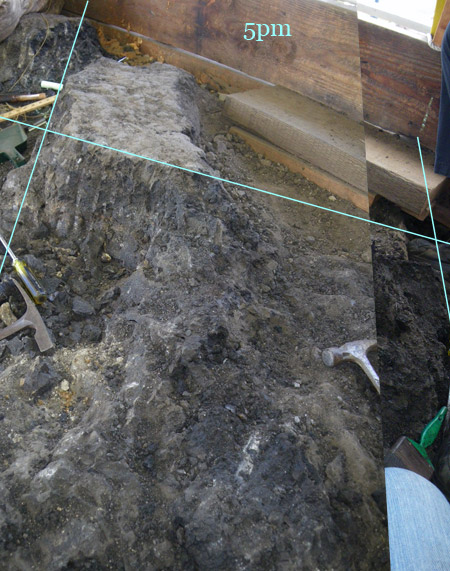
This is Grid D-3/Level 2 at 9am. Mouse over to see it at 5. Or, just scroll down:

D-3 is largely sterile, except for the occasional articulated millipede or bit of plant matter. This means we can power through it as quickly as our muscles allow. Spencer and I worked on D-3 all day, and chiseled out about 5 full buckets of matrix! Hard, hard work, as evidenced below:

6 blisters on my right hand! Badges of honor, all.
24 March 2009
Note from the Lone Male Excavator:
What is a fossil? One of our readers, "Duys" in Belgium recently reminded me of how one can determine a fossil and I thought it a good time to bring it up. I'll meet that idea in a round about way here:
The other day, I held the back door for a family visiting the museum. One of them was in a wheel-chair and since the back (staff) door is nearest the parking lot, could enter there. Anyway, I was heading into the lab and so held that door open too so that they could get a peek inside at Shelley and the volunteers eating lunch and glimpse behind the scenes fossil workstations. The older gentleman pushing the wheelchair asked me if I was a fossil... "I'm getting there," I replied. (Yes, the LME turns 30 in less than a month.) This question the gentleman asked was not one we get often, but we are very often asked if the bones and other previously living materials we dig out are, in fact, "fossils."
Strictly speaking, it depends on your definition of the word fossil. When I took Invertebrate Paleontology, my professor, in the first week, was discussing some common mistakes & misconceptions in word definitions. One he mentioned was archaeology vs. paleontology, between which this blogs readers surely already distinguish the differences and similarities (yes?). Another he discussed was the difference between "fossil remains" and "recent remains," as well as how to tell if what you have is a fossil. Being a geologist, he discussed the difference in whether or not the remains had undergone mineralization. He noted that a fossil will not smell if you hold fire to it. Furthermore, if you stick your tongue to a "recent" bone it will stick a bit, but it won't with a "fossil" bone.
Geologists and dinosaur paleontologists often use this sort of "mineralisation" definition, but how do La Brea bones hold up to it? Since they do still contain collagen, Rancho La Brea bones would, hypothetically, still produce a burning organic smell if we held them to fire. And, yes, ones tongue would likely stick to them if tried, but that may be more due to the asphalt than the collagen.
So I've decided to test these hypotheses with a personal experiment. (Of course, I am not serious.) We don't need to burn or lick these bones to determine that they have collagen, as studies have already used collagen samples from many of the bones in attempts to extract proteins and DNA.
So, are they not fossils?
A 30,000 year old bone is a fossil, no matter how you slice it. Ancient Rancho La Brea bones, plant, shells, and insect parts all fall under the more encompassing definition of fossil provided to us by thefreedictionary.com:
"A remnant or trace of an organism of a past geologic age, such as a skeleton or leaf imprint, embedded and preserved in the earth's crust."
The Rancholabrean North American Land Mammal Age (named for our site) spans from
300,000 to 11,000 years BP, so being of a past geologic age, our remains in this time frame are fossils.
Here is a question for you all:
Are the bones, plants, shells, insect parts, etc., that we find and can date to less than 11,000 YBP fossils? Pit 10 contained a vent of remains, for example, dated at around 9,000 years. So these are not technically from "a past geologic age." Are these bones not fossils?
Since Andrea alluded to it in a previous post, I have to mention that a month ago I sprained my left wrist when I rode the top of a ladder to the ground...backwards and downwards, and slam. I have missed my left hand terribly and promise to never take it for granted again if it works with me on the physical therapy and retains full functioning.
Lawyers need not contact me, as the staff here and NHM human resources department have been caring and accommodating.
Oh, and FYI:
We've completed excavation of Box/deposit 10B; our first box finished. It went pretty fast because it was a disturbed (mostly fallen apart) deposit and we did not measure out any bones or use a grid system on it. We will not, be changing the project name to Project 22, but the thought crossed our minds.
11 March 2009
help for the budding scientist
Earlier this week I received the following email from a future paleontologist, Adrienne:
Hey, Andie, I have to do a science fair experiment... the kind where you have to answer a question like, "What different fruits and veggies have more vitamin C?" (That's an example, I did it in 5th grade (2nd place!))
Anyway, I have been searching the interweb and have been so far coming up blank. I was wondering if you guys had any ideas, anything that you remember possibly doing?
We never had science fairs at my school, so I have no suggestions for young Adrienne. But you, dear readers -- any ideas? If so, please comment away
07 March 2009
weekly update/in the news: we're on basic cable!
Lab assistant Trevor Valle made a totally awesome -- personable, even -- appearance on G4's "Attack of the Show" this week. Clip is embedded below!
Trevor had a great time, Kevin was a great interviewer, and we're hoping this'll turn into a recurring thing. Their studios are across the street, after all...
Meanwhile, back at the project...

1) Check out the awesome lean-to that volunteer Richard Simun rigged up out of spare parts strewn about the excavation compound. We are well-shaded and sunburn-free!
2) The box was originally 2' taller than it is in the photograph; we've been removing slats from the tree box as we dig down. We'll be doing this for all of the deposits. It makes it easier to dig, and easier for the public to get a look at what we're digging.
Things you can't see in the picture above -- Ryan sprained his left wrist! But fortunately, he is going to be...

...a-ok. He's out of town now, but will have a "Note" on that sometime next week.
And though the sediment is a lot softer than that in Box 1 (I'm sitting next to it right now, with Spencer Bronte digging -- he just found a big bird bone!), it's not without its hazards:

I broke two screwdrivers this week while chiseling. Good time to test Craftsman's warranty, eh?
21 February 2009
Note from the Lone Male Excavator:

Inspired by our friend Jack Tseng's "What is this?" post, I've decided to place here a mystery bone and you all have to guess what it is. The winner will receive a short on-site tour of the Project 23 excavation site, or, if you are a Page Museum volunteer and have no prior knowledge of what it is, you will win a hearty handshake from the LME (Lone Male Excavator).
I want a specific answer, should be two parts: what bone is it? & what species (or I'll take family) is it?
Ideally, you should also say whether it is a right or a left and what developmental stage it is in (roughly how old was the animal).
20 February 2009
weekly update: back to basics
It has been one heck of a week here at Rancho La Brea; we were on almost every local news channel, the LA Times, the NY Times, the Brisbane Times, and even a couple papers from Norway ("We can not so many of these, such as deer to tigers sword" indeed!). In light of this newfound limelight (and in light of the exponential increase of blog subscribers!) I want to take a minute to get back to basics.
So for those just joining us: I'm Andie, and I work here, along with lead excavator Kristen Brown, fellow full-time excavator and lone male Ryan Long, and part-time excavators Michelle Tabencki and Laura Tewksbury. Project 23's intial beginnings are described in this blog post and many others found on this site. To date, we've excavated at least 700 fossils (and calculated a minimum number of individual animals of at least 2 dozen). Current tally includes at least:
-3 saber-tooth cats
-1 lynx
-1 North American lion
-6 dire wolves
-2 coyotes
-1 Harlan's Ground Sloth
-1 baby bison
-1 baby horse
-2 dwarf pronghorns
-LOTS of turtle
-at least 5 birds (including a teratorn!)
-LOTS of millipedes
-LOTS of oak leaves
and much much more
And our excavation site currently looks like this:
If anyone reading this works in the Variety building, we really want to take pictures from your rooftop...


looks like Laura found a fossilized meter stick!

It hasn't yielded nearly as many fossils as Deposit 1, but did give us an interesting piece of turtle which might be new to Rancho La Brea, so that's pretty nifty.

Box 10B -- 10A's smaller, slouchier half -- is also being worked on, but can't be seen from the fence. Part of it collapsed while APRMI was boxing it up, however, so we're not taking as much locational data as we usually do.

seriously: it is NOT A FOSSIL


Additionally, there have been a number of questions posted as blog comments over the past week, which we'll answer ASAP. But as for now, we have some serious digging to do.
3
comments

 Labels:
deposit 1,
deposit 10a,
deposit 10b,
deposit 5b,
How To,
In the news,
project 23,
weekly update
Labels:
deposit 1,
deposit 10a,
deposit 10b,
deposit 5b,
How To,
In the news,
project 23,
weekly update
 Labels:
deposit 1,
deposit 10a,
deposit 10b,
deposit 5b,
How To,
In the news,
project 23,
weekly update
Labels:
deposit 1,
deposit 10a,
deposit 10b,
deposit 5b,
How To,
In the news,
project 23,
weekly update
17 February 2009
In the news (again!)
Hey Angelenos -- Project 23 will be featured on the front page of the LA Times tomorrow! And be sure to check out their online photo gallery as well. And...
Hey early risers -- Project 23 will be on Good Morning, America tomorrow morning! We'll be popping up in all sorts of news outlets this week, so keep an eye out for more.
08 February 2009
In the news
Part-time excavatrix Laura Tewksbury has been busy! She sends us this link:
Whale Fossil for Concordia Elementary School
and writes:
"This was the first fossil preparation project I ever worked on, under paleontologist Greg Seymour. During high school, my mom would drive me over to volunteer at least once a week, and I got to both chip away at his (horrible, fine-grained, concrete-like) matrix and help teach the kids about paleontology. It's pretty much one of the main reasons I'm here [i.e. at Rancho La Brea]. I originally got involved through Dave Gerhard when he first moved to Concordia, since that was my old elementary school, my little sisters were still there, and my mom was PTA President.
How time flies. Like a whale on a hoist. "
Very cool, Laura!
06 February 2009
update: PROGRESS
Remember this?


But first, here are some interesting inferences about North American Lions, provided by our fair leader, collections manager Christopher A Shaw:
- North American Lions showed up in their eponymous continent (North America) around 400k years ago
- They were probably not social animals -- in other words, there were no prides of these particular lions. We think this for two reasons:
- We don't find nearly as many of them as we do dire wolves and sabertooth cats, and not with nearly the same range of ontogenetic age. For example, we've found approximately 6 North American Lions in Pit 91, compared to around 50 Saber-toothed Cats.
- In a pride of African lions, the ratio of males to females is 1:6 or 1:7. Here at Rancho La Brea the ratio is about 1:1. Thus: no African Lion-esque prides. North American Lions likely had a more solitary lifestyle, more akin to that of a mountain lion.
Back to our skull: after months of carefully using dental picks to clear out the surrounding matrix, we eventually had to resort to brute force to get the lion skull out.

Background soundtrack provided by: Marketplace with Kai Ryssdal on NPR; Laura Tewksbury singing; various lab volunteers cheering; and me saying "there's a frickin humerus attached to it!" A great orator, I am not...
Though quality on this video isn't the best, it is good enough to show just how tough it is to get something out of an asphaltic deposit. Even after putting all of my weight behind the skull, at first it barely moves. However, after some artful wiggling (and a decent amount of luck) it's out!

The skull itself is an absolutely beautiful specimen; it's the most complete P. atrox skull we've gotten out of the current excavations (i.e. Pit 91 and Project 23).

And now that the skull's out, we can get on with our excavation.

As for our skull...

Laura promptly carried it off to the lab, and rumor has it that Herb will begin cleaning it in a few weeks. We think we'll name it Fluffy.
Subscribe to:
Posts (Atom)

 Posts
Posts


