As I reported last post, we've moved back into the big box: Deposit 1!! And look how excited everyone is:
Volunteers Christina Lutz and Tara Thara. From Back in Dep 1
Those are the smiles of happy fossil finders. Why? Because they're actually finding fossils again! Between mostly planty deposit 7A, and really hard and sterile parts of deposit 1, we're been spending entirely too much time digging up dirt rather than fossils. Dirt = not fun. Fossils = awesome. It's very simple.
I've posted many, many pictures of this bone bed before (it's where we found our North American Lion skull and assorted long bones). And it's once again producing some really great feline finds:
The big dusty skull-looking thing on the bottom is a... big, dusty sabertoothed cat skull, with a complete sabertoothed cat pelvis immediately above it. And look a little above the skull and to the right:
And in the grid directly across from this one, we found 2 more sabertoothed cat kitten sabers:
Volunteer Steven Wintergerst holding a Smilodon kitten saber From Back in Dep 1
This may bring our (estimated) minimum number of sabertoothed cats in this deposit to around 7: 3-4 juveniles, 1 sub-adult (teenager) and at least 2 adults (I will have to double check these number with the lab). It's actually possible to match sabers to skulls, by taking casts of the alveolus (tooth socket) and comparing the cast to the tooth! This is something we might want to do in the distant future; because this deposit is so small we may be better able to discern which bones belong to which individual cat -- especially for these 4 "kittens" we've found. Yes, they're all young, but they're not of the exact same age (which makes me think this isn't a singular litter that got stuck). So by determining the age of each young sabertoothed cat bone we find, we can figure out whose limbs are whose, and then perhaps extrapolate from that how much the asphalt has moved/disturbed the skeletons since they first got stuck 10-40 thousand years ago.
2 partial turtle shells have come out of the formerly sterile areas west of the main bone deposit. Turtle shells are made out of a number of interlocking plates, and while the individual plates are extremely common, articulated/associated ones are not -- in fact, these may be the only even semi-complete shells we've ever found at Rancho La Brea. Trevor's been working on them in the lab, and has one of them somewhat reconstructed (which he will hopefully tell you all about at some later date if he ever gets around to making a blog post, hint hint).
She works here now! She likes rocks and photography and is generally great.
2) I don't often share links on here, but for those who are interested in science education in America and the general fight to keep evolutionary biology from being grievously misunderstood may find http://www.dontdissdarwin.com/ helpful.
Next post: so, what's in that barn-looking building next to the trailer?
Greg A. hunts for lunch by Pit 10 From Back in Dep 1
No, it is not dinosaur! It is a degreaser, which is far more useful and hopefully far less dangerous! More later.
they escaped from the tar pits, but not from each other: these two dragonflies were found flying around together, attached at the hip by asphalt. Michelle kindly helped free them. From 7A and back into 1
Right. So we've been working steadily in deposit 7A, and are about 1/2 a meter down in all areas. There were three bones immediately visible on the surface (all sliced by the tractor that found them, and horribly dried out), but other than that we've yet to find any substantial vertebrate fossil deposit. We've found a few scattered pieces of turtle shell (not to mention some extremely odd fragments of mineralized bone -- very rare for Rancho la Brea!) but none of the big jumbly bone masses we've come to know and love. What we have found:
These freshwater snail shells are further contextualized by the immense amount of plant material we've been getting out of the deposit as well; the northeastern corner of the deposit is filled with what appear to be tree branches (but possibly roots). Additionally, there's some interesting stratigraphy going on in this deposit: layers of river sand and large rounded rocks.
But as of yet no big vertebrate fossils. Boo.
For that reason (and because we're acutely aware we're already one year into a five year project!), we've put deposit 7A on hold, and re-doubled our efforts in deposit 1 (the big box we first started in).
And we've made some really impressive progress! But more on that next post. Until then, I leave you with this month's "What is it?" Check out the photo below, and leave a comment with your guess of species and element! Correct guesses win a congratulatory shout out on the next post, and the knowledge that they have bettered their internet peers!
I'll give you a hint: it's a fossil. From What is it?
Happy guessing!
28 July 2009
With Ryan gone, life is much daintier here at Rancho La Brea.
ping ping ping!
However, this does not mean that we are not still capable of great feats of strength:
once, this was a chisel. now, it is rubble. such is life.
as is evidenced by the still-growing pile of broken tools left in our wake (volunteer Meena broke this one...)
Thus, over the last week our girlie muscles have brought Deposit 7B down almost a meter below its original grade. 7B is small, and not densely fossiliferous, but nevertheless productive enough to stay interesting:
The femur is the latest of several sabertoothed cat bones we've excavated from this area (including a skull!), and we're wondering if they're all from the same individual animal. We won't know for sure until they're cleaned and officially identified by the folks in the lab.
Less immediately exciting, but still important: there's a huge chunk of rock hard oxidized asphalt right in the middle of the deposit. There are bones around this asphalt, but not in it. We think this might be a vent -- the fissure in the ground that the asphalt originally oozed up from! We've seen this in Pit 91 before, but haven't been able to observe it as well as now. We only worked in Pit 91 for 12 weeks out of the year, and would only excavate a fraction of the exposed grids each season. This means that though interesting geological features were documented, it would sometimes take years to see if they continued another foot below the surface -- just because it took us that long to excavate the entire floor. Working year round with smaller deposits is allowing us to focus on unexpected geologic/taphonomic environments like this one.
I mentioned the lab earlier, and soon we'll have a proper Update From Indoors but until then:
here's a soundtrack-less time lapse of the preparation of Zed's right femur. Still a work in progress, but you get the general idea. Email subscribers: visit excavatrix.blogspot.com to see the video. Or scroll down:
to see Zed's femur in it's shiny, well polished glory.
Hello! We found a very neat thing a few weeks ago:
It's a bird! It's a plane! It's-- wait, nope, it's a bird. The many small bones in the upper left-hand corner (with the big arrow pointing at them labeled "bird") are all from a small passerine, (or "perching bird"). These bones likely represent an associated individual; they were found in a slightly separate layer of asphaltic sand than the rest of the deposit, and some bones even appear to be somewhat articulated. In other words: this is the almost complete skeleton of a small bird; this is extremely rare; I have named him Kevin.
Though most birds are passerines, they are nevertheless rare at Rancho La Brea; our collections are dominated by bigger birds of prey like teratorns and condors. It's hard to say what species Kevin is, exactly -- especially without cleaning and preparing the bones first -- but Lab Supervisor Shelley says he's about the size of a scrubjay.
The bones in the numbered in this photo are as follows:
carpometacarpus
scapula
2 limb bones -- not sure which exactly
sternum
tibiotarsus? I think?
tarsometatarsus
femur?
The photo above was taken after removing a number of other bones separately, such as ...
the furculum...
another scapula...
...and a humerus (as well as an articulated synsacrum and femur, several vertebrae, and several phalanges that I don't currently have photos for). After removing these uppermost bones and discovering there were even more underneath we decided to remove the rest of the skeleton in one block...
which was accomplished by gently prying the layer of asphaltic sand it was rested in with well-placed screwdrivers and chisels.
Though this skeleton is exciting in and of itself, its context may actually be more important. As regular blog readers may remember, up until now Deposit 1 has been more dirt than fossils. There's a dense cluster of bones in the southeast corner that has yielded at least 1000 specimens (and at least that many more to come), but about 3/4ths of the box has been largely sterile. Not anymore. As we dig deeper into the so-called "sterile" areas, we've found a new layer of fossils:
This is a different style of deposition than in the "main" bone cluster we've previously worked on:
These fossils are spaced further apart, and spread out more evenly -- not all jumbled together like pick-up-sticks.
These bones are broken, weathered, and worn. The bones in the other cluster are largely complete
Many of the longer bones and bone fragments point in the same direction (scroll back up to the top of the page to get a closer look) -- perhaps implying stream movement? We don't know! But it's interesting...
Kevin was found in the northwest corner of this grid (near where the meter sticks cross) in a slightly separate layer of asphaltic sand -- perhaps implying that he flew in and got stuck after the rest of these unlucky beasts? Again -- we don't know! But also interesting! We will keep you posted as things and finds progress.
OH, we have been bad bloggers. Apologies for the complete and total lack of communication. BUT, in our defense, we've been really busy. Look:
This is Deposit 7B, and it is open for excavation. Now that 10A and 10B are done, lead excavatrix Kristen and curatorial assistant Aisling decided that the 7's would be next to go (while continuing work on the never-ending saga that is Deposit 1). According to APRMI's field notes and photos, the 7's are pretty fossiliferous -- more so than 10A and 10B, anyway -- and so far, the sediment hasn't been terribly hard -- good for excavators' hands, good for the fossils' relative safety.
Serendipitously enough: Shelley et al in the lab just opened another plaster jacket in the lab labeled "mammoth" only to find that it's actually half of a Giant Ground Sloth pelvis from near Deposit 7. Other finds from 7B:
From top to bottom: the ischium of a bison pelvis, an herbivore (possibly bison) rib, a cervical vertebra from a sabertoothed cat, a bit of plant, and a dire wolf humerus. We've also recovered another sabertoothed cat vertebra, another herbivore (possibly bison) rib, and a small piece of maxilla that may belong to a small dog or a mustelid of some sort -- we won't know until it's clean.
So, why has this taken up so much time? Well, I'll tell you:
Opening a new box/deposit isn't as simple as lifting up a tarp and digging in. First, we have to determine the box's original cardinal orientation -- that is, we have to figure out what side of the box originally faced north. More often than not, our imaginary north arrow isn't actually perpendicular to the northernmost side of the box; it's at an angle that can only be determined by carefully referencing original field notes from the salvage. It's only after we figure that out that we can set our grid lines, and begin digging. The diagram above (mid-pass from me to Laura) is a sketch of the overall layout of Deposit 7B, with every grid labeled, and the angle of that imaginary north arrow recorded for future reference. Did all that makes sense? If not -- comment, and I'll explain better next post.
So what else have we been doing?
The Page Museum hosted an Art + Science event in conjunction with LACMA's art walk. I put this 4 minute time lapse film-lette together for it -- PLEASE watch it; I think it turned out quite nicely! Time lapse experiments are largely responsible for stealing the time I would ordinarily spend updating the blog -- sorry! -- but I hope you will agree that the results have been worthwhile.
LACMA's art walk invaded our side of the park in a pleasantly chaotic sort of way:
These partially constructed hexagons of what would have been a geodesic dome spotted the hill surrounding the museum.
And these white and black tarps surrounded our sloth and bear sculptures! By the end of the day, they were re-purposed somewhat...
...as awesome space age forts for young paleontologists. More pictures, as always, if you click on the picture above and explore our flickr photo feed.
...especially when I'm MIA, or if more than 140 characters is just too much for you.
Finally, Michelle has recently discovered her true calling: she is a poet, and she didn't know it. Her specialty: the ancient Japanese form of poetry known as the haiku:
Working in Box 1 Ouch! I hit my hand again! Chiseling is hard.
Dermal ossicles There are many in this grid. Natural defense
Glossotherium Haikus can be so random. Cheese quesadilla
Like I said, we've been very busy! Next update will be prompter, I promise!
Yes indeedy, as Ryan pointed out last week, we have finished excavating our very first deposit from Project 23:
10B is no more! And its big sister 10A is soon to follow:
We're down to Project 21-and-a-half. The small patch of fossils from this deposit seems to have petered out. We can't be sure, but we're thinking the remaining few feet of dirt are largely -- if not entirely sterile. The boundaries between grids are left in place until they're completely exposed, and then mapped and photographed. This way, we can reconstruct the deposit's geology long after the deposit has been excavated.
And 5B looks much the same is it did last time I posted, only sans a level of plywood around the sides.
We're waiting to speak to one of the geologists who originally supervised the salvage before we begin digging.
Meanwhile, in Deposit 1....
We're still plugging away at the main bone jumble in Box 1. We've measured out at least another 100 fossils from this area. Right now, however, we're at a bit of a standstill, stuck between a rock and a hard place so to speak. Or rather, a scapula (shoulder blade) and an innominate (one half of a pelvis):
Pleistocene pick-up sticks once again! From left to right: we can't get the first innominate out without removing the scapula immediately above it, but we can't get that scapula out because of the saber cat vertebra immediately above it. THAT's stuck under the middle scapula, which is in turn pinned in place by next-to-last scapula, which is, of course, covered by both a cat humerus (lion or saber cat, not sure though) and yet another scapula.
This is all very detailed, very slow work. However, on the other side of Box 1, we get the other end of the paleo-work perspective:
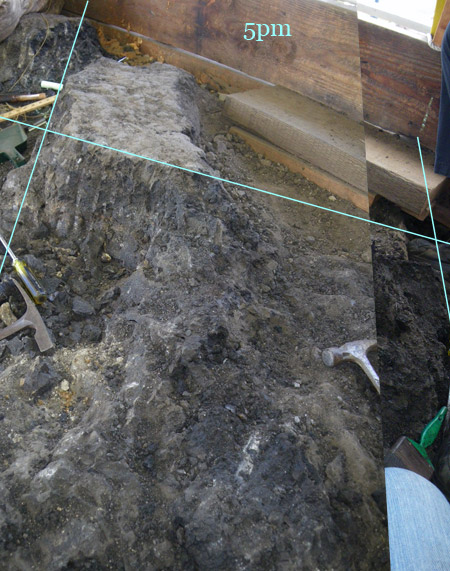
This is Grid D-3/Level 2 at 9am. Mouse over to see it at 5. Or, just scroll down:
D-3 is largely sterile, except for the occasional articulated millipede or bit of plant matter. This means we can power through it as quickly as our muscles allow. Spencer and I worked on D-3 all day, and chiseled out about 5 full buckets of matrix! Hard, hard work, as evidenced below:
6 blisters on my right hand! Badges of honor, all.
Lab assistant Trevor Valle made a totally awesome -- personable, even -- appearance on G4's "Attack of the Show" this week. Clip is embedded below!
Trevor had a great time, Kevin was a great interviewer, and we're hoping this'll turn into a recurring thing. Their studios are across the street, after all...
Meanwhile, back at the project...
We've taken a break from the large deposit -- Box 1 -- to focus on the little crate that could -- Box 10B. It's about 5' x 5' x 4' deep, and filled with wonderfully soft and squishy asphaltic sand and dirt -- SO much easier to excavate than Box 1. Not nearly as dense a deposit as Box 1, but we have found a wide range of rodent, rabbit and bird bones (including a beak), some dermal ossicles, and the jaw of a dwarf pronghorn. We're making quick work of this deposit; it's been open for about a month, and we're already more than half way done with it. Two things to note in this picture: 1) Check out the awesome lean-to that volunteer Richard Simun rigged up out of spare parts strewn about the excavation compound. We are well-shaded and sunburn-free! 2) The box was originally 2' taller than it is in the photograph; we've been removing slats from the tree box as we dig down. We'll be doing this for all of the deposits. It makes it easier to dig, and easier for the public to get a look at what we're digging.
Things you can't see in the picture above -- Ryan sprained his left wrist! But fortunately, he is going to be...
...a-ok. He's out of town now, but will have a "Note" on that sometime next week.
And though the sediment is a lot softer than that in Box 1 (I'm sitting next to it right now, with Spencer Bronte digging -- he just found a big bird bone!), it's not without its hazards:
I broke two screwdrivers this week while chiseling. Good time to test Craftsman's warranty, eh?
It has been one heck of a week here at Rancho La Brea; we were on almost every local news channel, the LA Times, the NY Times, the Brisbane Times, and even a couple papers from Norway ("We can not so many of these, such as deer to tigers sword" indeed!). In light of this newfound limelight (and in light of the exponential increase of blog subscribers!) I want to take a minute to get back to basics.
So for those just joining us: I'm Andie, and I work here, along with lead excavator Kristen Brown, fellow full-time excavator and lone male Ryan Long, and part-time excavators Michelle Tabencki and Laura Tewksbury. Project 23's intial beginnings are described in this blog post and many others found on this site. To date, we've excavated at least 700 fossils (and calculated a minimum number of individual animals of at least 2 dozen). Current tally includes at least: -3 saber-tooth cats -1 lynx -1 North American lion -6 dire wolves -2 coyotes -1 Harlan's Ground Sloth -1 baby bison -1 baby horse -2 dwarf pronghorns -LOTS of turtle -at least 5 birds (including a teratorn!) -LOTS of millipedes -LOTS of oak leaves and much much more
And our excavation site currently looks like this:
If anyone reading this works in the Variety building, we really want to take pictures from your rooftop...
Deposit 1 (on the right) is the first one APRMI found during the salvage, the biggest box overall, and the first one we started digging in. Also, it looks like a pirate ship, which pleases us immensely.
Deposit 10A (more lifeboat sized...) is also being actively worked on.
looks like Laura found a fossilized meter stick!
It hasn't yielded nearly as many fossils as Deposit 1, but did give us an interesting piece of turtle which might be new to Rancho La Brea, so that's pretty nifty.
Box 10B -- 10A's smaller, slouchier half -- is also being worked on, but can't be seen from the fence. Part of it collapsed while APRMI was boxing it up, however, so we're not taking as much locational data as we usually do.
And finally, Box 5B. We just opened this one a couple weeks ago, mostly to get an idea of what our next area of focus will be when we finish the 10s. We won't actively begin excavation until they're done. However, we've already found some neat stuff in it...
seriously: it is NOT A FOSSIL
...like this NOT FOSSIL wasp nest. It was on the side of the box under the tarp (again, NOT A FOSSIL). A neat instance of modern life co-existing (well, until the nest was abandoned..) with the extinct.
We continue to excavate 7 days a week (except for bank holidays and whatnot) and will happily talk to you if you stop by, provided we are not lunching, operating heavy machinery, or performing particularly delicate fossil extractions, and you do not try to throw things or yell rude questions (i.e. "Did you find my lost contact yet? Hyuk hyuk hyuk.") at us. We love our jobs, and love sharing our discoveries with you, and THANK YOU for your continued interest and support of natural sciences in general, and Project 23 in particular!
Additionally, there have been a number of questions posted as blog comments over the past week, which we'll answer ASAP. But as for now, we have some serious digging to do.
1. the feminine form of excavator; a woman employed to dig out earth 2. the semi-official blog of the excavators and excavatrices at the La Brea Tar Pits in Los Angeles, CA.