When we last left our heroes:
They were digging away at deposit 5B. And the still are! The deposit has shrunk considerably from its original size, but excavators are still looking for more elements of Clyde, our partially articulated, partially complete Camelops hesternus.
As you may remember from two posts ago, we had most recently exposed his almost perfectly articulated 7th cervical and first thoracic vertebrae, and were pleased to find that his 6th cervical vertebra wasn't too far off:
06 June 2010
camelops!
21 February 2010
we're back!
Friends, I am torn, because on the one hand, I feel extremely bad for not posting for two months, but on the other hand, it is because we have been busy being amazingly productive paleontologists who do not have time for this new-fangled computer contraption -- we simply have too much dirt, too many bones, too much science. Am I to apologize for progress? I think not. But am I to apologize for poor journalism? Absolutely.
As penance, I humbly offer you easily enough material for three separate posts. Photo heavy, be warned.
![]() |
| From New Year, New Dirt |
![]() |
| From New Year, New Dirt |
![]() |
| From New Year, New Dirt |
![]() |
| From New Year, New Dirt |
![]() |
| Jack is so proud! From New Year, New Dirt |
![]() |
| Pat Simun wins MVV (most valuable volunteer) From New Year, New Dirt |
![]() |
| If only lasers actually worked this well. From New Year, New Dirt |
![]() |
| From New Year, New Dirt |
![]() |
| From New Year, New Dirt |
So far we've recovered its humerus:
![]() |
| From New Year, New Dirt |
![]() |
| From New Year, New Dirt |
| Kristen's forearms are awesomely recognizable. From New Year, New Dirt |
![]() |
| From New Year, New Dirt |
![]() |
| From New Year, New Dirt |
![]() |
| From New Year, New Dirt |
![]() |
| From New Year, New Dirt |
![]() |
| From New Year, New Dirt |
![]() |
| From New Year, New Dirt |
![]() |
| From New Year, New Dirt |
![]() |
| Well, I suppose that's better than a fork... From New Year, New Dirt |
![]() |
| From New Year, New Dirt |
![]() |
| From New Year, New Dirt |
![]() |
| From New Year, New Dirt |
![]() |
| From New Year, New Dirt |
![]() |
| From New Year, New Dirt |
![]() |
| From New Year, New Dirt |
16 November 2009
update: more sabertoothed cats and kittens
| Solar flares over our pulley. From Back in Dep 1 |
| Volunteers Christina Lutz and Tara Thara. From Back in Dep 1 |
Those are the smiles of happy fossil finders. Why? Because they're actually finding fossils again! Between mostly planty deposit 7A, and really hard and sterile parts of deposit 1, we're been spending entirely too much time digging up dirt rather than fossils. Dirt = not fun. Fossils = awesome. It's very simple.
I've posted many, many pictures of this bone bed before (it's where we found our North American Lion skull and assorted long bones). And it's once again producing some really great feline finds:
| Sabertoothed cat skull! From Back in Dep 1 |
The big dusty skull-looking thing on the bottom is a... big, dusty sabertoothed cat skull, with a complete sabertoothed cat pelvis immediately above it. And look a little above the skull and to the right:
| Smilodon saber in situ. From Back in Dep 1 |
It's a complete sabertoothed cat saber!
| Smilodon saber in one piece! From Back in Dep 1 |
| Volunteer Steven Wintergerst holding a Smilodon kitten saber From Back in Dep 1 |
This may bring our (estimated) minimum number of sabertoothed cats in this deposit to around 7: 3-4 juveniles, 1 sub-adult (teenager) and at least 2 adults (I will have to double check these number with the lab). It's actually possible to match sabers to skulls, by taking casts of the alveolus (tooth socket) and comparing the cast to the tooth! This is something we might want to do in the distant future; because this deposit is so small we may be better able to discern which bones belong to which individual cat -- especially for these 4 "kittens" we've found. Yes, they're all young, but they're not of the exact same age (which makes me think this isn't a singular litter that got stuck). So by determining the age of each young sabertoothed cat bone we find, we can figure out whose limbs are whose, and then perhaps extrapolate from that how much the asphalt has moved/disturbed the skeletons since they first got stuck 10-40 thousand years ago.
| New excavator Carrie Howard! From Back in Dep 1 |
She works here now! She likes rocks and photography and is generally great.
| Greg A. hunts for lunch by Pit 10 From Back in Dep 1 |
08 July 2009
a small but big discovery
Hello! We found a very neat thing a few weeks ago:
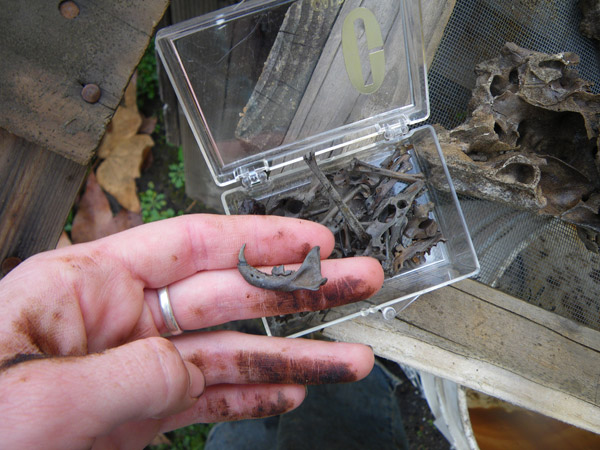
It's a bird! It's a plane! It's-- wait, nope, it's a bird. The many small bones in the upper left-hand corner (with the big arrow pointing at them labeled "bird") are all from a small passerine, (or "perching bird"). These bones likely represent an associated individual; they were found in a slightly separate layer of asphaltic sand than the rest of the deposit, and some bones even appear to be somewhat articulated. In other words: this is the almost complete skeleton of a small bird; this is extremely rare; I have named him Kevin.
Though most birds are passerines, they are nevertheless rare at Rancho La Brea; our collections are dominated by bigger birds of prey like teratorns and condors. It's hard to say what species Kevin is, exactly -- especially without cleaning and preparing the bones first -- but Lab Supervisor Shelley says he's about the size of a scrubjay.
The bones in the numbered in this photo are as follows:
- carpometacarpus
- scapula
- 2 limb bones -- not sure which exactly
- sternum
- tibiotarsus? I think?
- tarsometatarsus
- femur?
...and a humerus (as well as an articulated synsacrum and femur, several vertebrae, and several phalanges that I don't currently have photos for). After removing these uppermost bones and discovering there were even more underneath we decided to remove the rest of the skeleton in one block...
which was accomplished by gently prying the layer of asphaltic sand it was rested in with well-placed screwdrivers and chisels.Though this skeleton is exciting in and of itself, its context may actually be more important. As regular blog readers may remember, up until now Deposit 1 has been more dirt than fossils. There's a dense cluster of bones in the southeast corner that has yielded at least 1000 specimens (and at least that many more to come), but about 3/4ths of the box has been largely sterile. Not anymore. As we dig deeper into the so-called "sterile" areas, we've found a new layer of fossils:
This is a different style of deposition than in the "main" bone cluster we've previously worked on:
- These fossils are spaced further apart, and spread out more evenly -- not all jumbled together like pick-up-sticks.
- These bones are broken, weathered, and worn. The bones in the other cluster are largely complete
- Many of the longer bones and bone fragments point in the same direction (scroll back up to the top of the page to get a closer look) -- perhaps implying stream movement? We don't know! But it's interesting...
30 December 2008
meanwhile, back in the lab (part II)
When Shelley & Co. were about halfway done preparing Zed the Mammoth's thoracic vertebrae, they decided to open another plaster jacket: jacket #4, Zed's mandible! Their reasons were thus:
1) mammoth jaw means mammoth teeth. And mammoth teeth are excellent at revealing age. We already knew that Zed was fairly old when he died -- he's huge, for one thing, and there's evidence of arthritis on a number of his ribs, for another -- but we didn't know how old. Elephant tooth replacement occurs in very specific patterns, at very specific ages. They go through a total of 6 sets of molars in their lifetime, each molar slowly wearing down and getting pushed out by the one behind it. By comparing Zed's tooth wear to that of an African elephant, we can make a fairly accurate estimation of his age at death.
2) we have two extremely delicate mammoth tusks awaiting preparation. Working on Zed's similar-but-sturdier molars first may allow us to prepare for the tusks' preparation.
3) a very nice field producer from a very entertaining television show asked Shelley very politely to pretty please let them film the opening of the mammoth jaw jacket -- Shelley acquiesced. More on this when the time is right... [editor's note: oops, looks like I'm wrong. It was the thoracic vertebrae jacket that was opened on camera -- not the mandible jacket. Guess the field producer wasn't quite nice enough...]
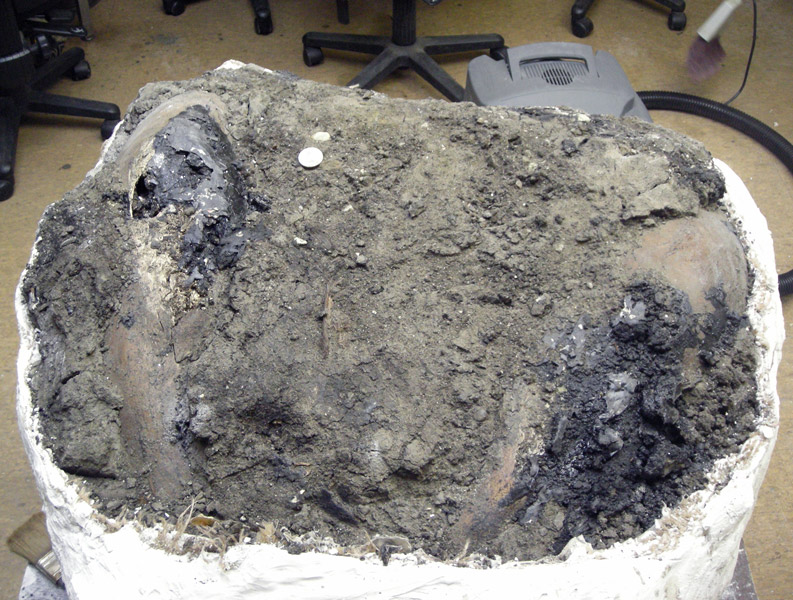
Long story short: jacket number 4, containing mammoth mandible, was opened. And it looked like this:
Yuck! We were saddened to discover that a) the jaw is upside-down (no visible teeth means we must wait to learn Zed's true age!) and b) a tractor shaved off the bottom-most edges of the jaw, leaving what we in the business euphemistically call "discovery marks."
As you can see, Zed's matrix (the dirt surrounding the fossil)is primarily dusty brown clay -- not the dark, sticky asphaltic sand we find in Pit 91. This is good and bad -- good: it's easy to dig through; bad: it's dusty and dry. Dry means there's less asphalt in Zed's skeleton over-all; his bones may be a bit more fragile than many others found at Rancho La Brea. Shelley therefore decided to repair the bottom of Zed's jaw, giving it a solid base to rest on and preventing further damage. After the bottom half was cleaned and ready to flip, the jaw was built up with gray putty:
And a wooden base was constructed around it:
That pink stuff is cellophane. That wooden box is about to be filled with expanding foam, which will create a perfectly customized cradle for the jaw to rest it. The cellophane -- in addition to being quite fetching -- will keep the foam from sticking to bone.
Trevor assisting on the left, Shelley pouring on the right. The foam is created by mixing two separate fluids together, and waiting:
Look! It's Herb, waiting patiently! Herb is awesome; he volunteers here, and at the LA Zoo, and with the Dinosaur Institute at the LA Natural History Museum. He's basically enmeshed with every natural history organization in the greater Los Angeles area. I think he's trying to take over.
Anyway: the foam! It rises, like bread, but far less tasty:
Trevor shaved the few errant remnants, and then:
Yay! It's done! What a beautiful mandible base! The jaw itself was then very carefully turned, and placed into the base. Trevor removed another layer of plaster, and soon enough, Zed's molars finally revealed themselves.
Zed's on his last set of molars -- a pair of M3's. Mammoth teeth are similar to elephants in that they're made up of a series of undulating plates. These teeth erupt one after another, almost continuously throughout their lifetimes, and plates are worn down from front to back. Based on the amount of wear on Zed's teeth, Shelley estimates Zed's age at 47 years (+/- 2). Zed wasn't ancient, but he definitely would have qualified for AARP membership.
If mammoths lived as long as African elephants live now -- up to 60 years -- then Zed could have had another decade in him, had an asphalt seep not caused his tragic end. However, Zed's jaw contains a rather unexpected hint at what kind of life Zed would have lived. Look at the front of the jaw, between his molars, where his tongue would have rested:
That weird, drippy growth is pathological -- that is, it's not normal. While mammoths typically do have a kind of "spout" in that area -- sometimes it angles down, sometimes it points straight out -- they don't have the weird, bumpy, lopsided growth that Zed shows here. But here's the thing -- yeah, we know that growth is pathological. But just because it's weird doesn't mean it's necessarily uncommon. We have far fewer mammoths in our collection than we spoiled Rancho La Breans are used to dealing with -- 30-32, compared to thousands of dire wolves. And we have even fewer pieces of mammoth jaw. There are approximately five mammoth mandibles in our collection in which that particular feature (the mandibular symphysis) is more or less intact -- and certainly none anywhere as complete as Zed's. So it's hard to say if this growth is unusual or not. Who knows -- many mammoth mouths could have been lopsided and bumpy like Zed's. We won't know until we find more mammoths. All the more reason to keep digging.
But here's the other thing: several of Zed's other bones have pathological elements to them -- arthritic joints, broken and re-healed ribs. It's looking more and more as if Zed lived a pretty rough life. In fact, the latest jacket Shelley and Trevor opened -- just last week! -- contains another hint at Zed's life. But more on that next week. Or rather, next year. Whatever -- Happy new year!