
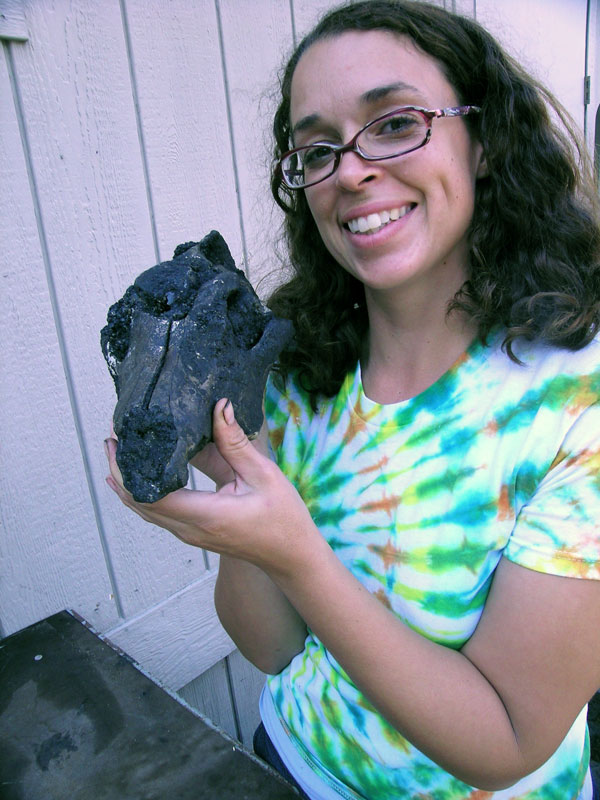
Too busy for a proper post, but if you click the photo above, you'll be taken to our flickr site, where I just uploaded about a dozen pictures from the filming of Dirty Jobs. More pictures next week, because friends, paleontology waits for no woman. We've had an extremely productive week, and just two short hours ago, we FINALLY got the North American Lion skull out of deposit 1. And let me tell you, it is a beaut. So once we're done basking in the glory of a job well done, we'll get back to blogging. Cheers!
23 January 2009
update-ish
Too busy for a proper post, but if you click the photo above, you'll be taken to our flickr site, where I just uploaded about a dozen pictures from the filming of Dirty Jobs. More pictures next week, because friends, paleontology waits for no woman. We've had an extremely productive week, and just two short hours ago, we FINALLY got the North American Lion skull out of deposit 1. And let me tell you, it is a beaut. So once we're done basking in the glory of a job well done, we'll get back to blogging. Cheers!


21 January 2009
DIRTY JOBS!

l to r: Kristen Brown, Andrea Thomer, Michelle Tabencki (the happiest girl in the world), Mike Rowe (working the purple bandana like no other), and Laura Tewksbury
We excavators and excavatrices made our television debut last night on the Discovery Channel's totally awesome show, Dirty Jobs! Mike Rowe came by a few months ago to help us with Pit 91 maintenance. Tar pits were glopped, shoring boards replaced, fossils excavated, cell phones inexplicably thrown: in short, a good time was had by all. I have to say, Mike, Dave Barsky, and the rest of the Dirty Jobs crew were the nicest, funniest, and generally raddest film crew we've ever hosted at the pits, so many thanks to them for being great (and for not editing us to look like madwomen) (or rather, editing us so that you can't tell we're really madwomen).
Now. We have a TON of pictures from the filming of the episode, which will be posted to our flickr channel by week's end. AND we have a good amount of incrimintating footage of Michelle, excavatrix and sponge bather extraordinaire, which will hopefully be posted to youtube soonish (provided she lets me...). And AND for those of you that missed it, the episode will be playing again this Friday at 8pm on the Discovery Channel. Set your collective Tivos. And check back on Friday for more pictures and stories and tomfoolery.

go team awesome! l to r: Chris Shaw, Kristen Brown, Trevor Valle, Laura Tewksbury, Aisling Farrell, Michelle Tabencki, Ryan Long, Andie Thomer
Yay!
Yay!
13 January 2009
update

happy non-denominational seasons greetings and new year
It is 85 degrees Fahrenheit in Los Angeles right now. In January. In what is supposed to be the dead of winter. We are mildly confused, but not complaining; digging in asphalt is so much easier in the warm sun! The matrix in two particular grids -- A-1 and A-2 -- has been soft enough to dig through using our fingers. Findings of note:

This jaw is from a small wildcat, most likely a Lynx, per collections manager Christopher Shaw. We don't have that many bones from smaller cats in our collection at the Page Museum for two reasons: 1) these smaller cats were likely solitary, so when they got stuck in an asphalt seep, they got stuck alone -- not with 15 of their closest friends, as with Dire Wolves and Saber-toothed Cats. 2) smaller cats have small bones, and early fossil collectors (during the early 1900s) would have likely passed them over for larger, more obviously interesting fossils like, again, those of the Saber-toothed Cat. This is what's called a collection bias: the arbitrary favoring of one kind of fossil or specimen over another. One of the main goals of the excavation in Pit 91 and with Project 23 is to correct this bias. Thus, we collect and keep everything -- even the stuff that might not seem obviously important at the time. For instance:

In grid A-2/Level 3 I found two bird tibiotarsi (i.e. drumsticks) immediately on top of one another. They're definitely from the same species (but I don't know which one), one tibiotarsus was a left and the other was a right, and they are about the same size. This may be a case of association (two fossils from the same individual animal), or it may be just a really weird coincidence. But it kind of doesn't matter: it's an unusual enough case to warrant thorough documentation. Pictures, notes, and measurements have been taken, and preserved for posterity. I am but a lowly excavatrix -- not a proper paleontologist -- and I haven't the years of schooling necessary to interpret this assemblage. But good data collection will hopefully benefit actual paleontologists of the future, as they dive through field notes and make the interpretations that we excavators couldn't. Ryan, our sole man, noted the following:

The orange bits are a complete oak leaf found from a largely sterile portion of Deposit 1. We've found a large number of plant parts, and a good number of oak leaves in this deposit. We don't know what plant is worth collecting and what isn't, so we try to collect as much as possible. Again, this is something for future scientists to interpret. And it's our job to make sure everything's collected in as complete a manner as possible. Finally, an eagle-eyed volunteer (hi Spencer) spotted the following:

a pile of orange dirt. While this wouldn't be surprising in any other fossil deposit, anything with any hint of color at the La Brea Tar Pits is worth noting. So a sample was collected, notes were taken, and hopefully this will give us some insight into the depositional environment around this particular deposit.
30 December 2008
meanwhile, back in the lab (part II)
When Shelley & Co. were about halfway done preparing Zed the Mammoth's thoracic vertebrae, they decided to open another plaster jacket: jacket #4, Zed's mandible! Their reasons were thus:
1) mammoth jaw means mammoth teeth. And mammoth teeth are excellent at revealing age. We already knew that Zed was fairly old when he died -- he's huge, for one thing, and there's evidence of arthritis on a number of his ribs, for another -- but we didn't know how old. Elephant tooth replacement occurs in very specific patterns, at very specific ages. They go through a total of 6 sets of molars in their lifetime, each molar slowly wearing down and getting pushed out by the one behind it. By comparing Zed's tooth wear to that of an African elephant, we can make a fairly accurate estimation of his age at death.
2) we have two extremely delicate mammoth tusks awaiting preparation. Working on Zed's similar-but-sturdier molars first may allow us to prepare for the tusks' preparation.
3) a very nice field producer from a very entertaining television show asked Shelley very politely to pretty please let them film the opening of the mammoth jaw jacket -- Shelley acquiesced. More on this when the time is right... [editor's note: oops, looks like I'm wrong. It was the thoracic vertebrae jacket that was opened on camera -- not the mandible jacket. Guess the field producer wasn't quite nice enough...]
Long story short: jacket number 4, containing mammoth mandible, was opened. And it looked like this:
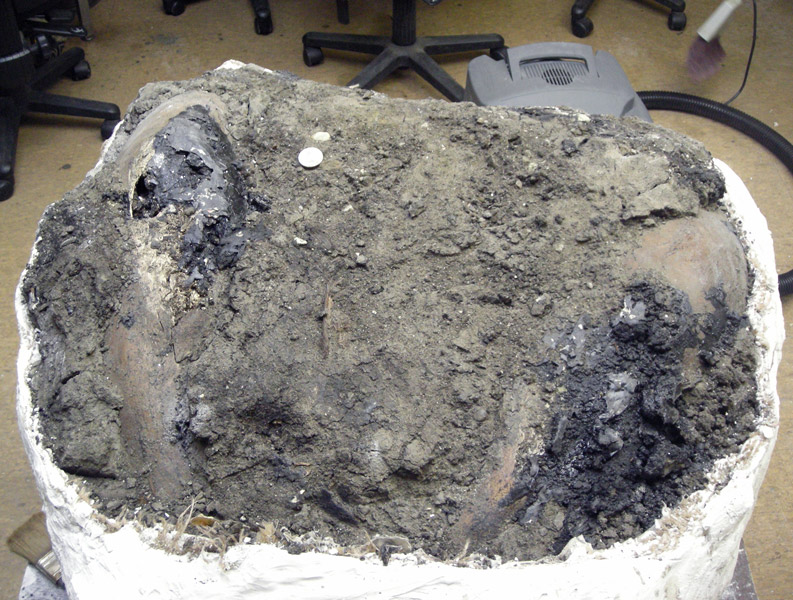
Yuck! We were saddened to discover that a) the jaw is upside-down (no visible teeth means we must wait to learn Zed's true age!) and b) a tractor shaved off the bottom-most edges of the jaw, leaving what we in the business euphemistically call "discovery marks."

As you can see, Zed's matrix (the dirt surrounding the fossil)is primarily dusty brown clay -- not the dark, sticky asphaltic sand we find in Pit 91. This is good and bad -- good: it's easy to dig through; bad: it's dusty and dry. Dry means there's less asphalt in Zed's skeleton over-all; his bones may be a bit more fragile than many others found at Rancho La Brea. Shelley therefore decided to repair the bottom of Zed's jaw, giving it a solid base to rest on and preventing further damage. After the bottom half was cleaned and ready to flip, the jaw was built up with gray putty:

And a wooden base was constructed around it:

That pink stuff is cellophane. That wooden box is about to be filled with expanding foam, which will create a perfectly customized cradle for the jaw to rest it. The cellophane -- in addition to being quite fetching -- will keep the foam from sticking to bone.

Trevor assisting on the left, Shelley pouring on the right. The foam is created by mixing two separate fluids together, and waiting:

Look! It's Herb, waiting patiently! Herb is awesome; he volunteers here, and at the LA Zoo, and with the Dinosaur Institute at the LA Natural History Museum. He's basically enmeshed with every natural history organization in the greater Los Angeles area. I think he's trying to take over.
Anyway: the foam! It rises, like bread, but far less tasty:

Trevor shaved the few errant remnants, and then:


Yay! It's done! What a beautiful mandible base! The jaw itself was then very carefully turned, and placed into the base. Trevor removed another layer of plaster, and soon enough, Zed's molars finally revealed themselves.

Zed's on his last set of molars -- a pair of M3's. Mammoth teeth are similar to elephants in that they're made up of a series of undulating plates. These teeth erupt one after another, almost continuously throughout their lifetimes, and plates are worn down from front to back. Based on the amount of wear on Zed's teeth, Shelley estimates Zed's age at 47 years (+/- 2). Zed wasn't ancient, but he definitely would have qualified for AARP membership.

If mammoths lived as long as African elephants live now -- up to 60 years -- then Zed could have had another decade in him, had an asphalt seep not caused his tragic end. However, Zed's jaw contains a rather unexpected hint at what kind of life Zed would have lived. Look at the front of the jaw, between his molars, where his tongue would have rested:

That weird, drippy growth is pathological -- that is, it's not normal. While mammoths typically do have a kind of "spout" in that area -- sometimes it angles down, sometimes it points straight out -- they don't have the weird, bumpy, lopsided growth that Zed shows here. But here's the thing -- yeah, we know that growth is pathological. But just because it's weird doesn't mean it's necessarily uncommon. We have far fewer mammoths in our collection than we spoiled Rancho La Breans are used to dealing with -- 30-32, compared to thousands of dire wolves. And we have even fewer pieces of mammoth jaw. There are approximately five mammoth mandibles in our collection in which that particular feature (the mandibular symphysis) is more or less intact -- and certainly none anywhere as complete as Zed's. So it's hard to say if this growth is unusual or not. Who knows -- many mammoth mouths could have been lopsided and bumpy like Zed's. We won't know until we find more mammoths. All the more reason to keep digging.
But here's the other thing: several of Zed's other bones have pathological elements to them -- arthritic joints, broken and re-healed ribs. It's looking more and more as if Zed lived a pretty rough life. In fact, the latest jacket Shelley and Trevor opened -- just last week! -- contains another hint at Zed's life. But more on that next week. Or rather, next year. Whatever -- Happy new year!
23 December 2008
meanwhile, back in the lab (part I)...
As temperatures turn colder, it's time for The Excavatrix to turn attention to warmer, more indoor activities -- such as the preparation of mammoth fossils in the lab (not that we excavators aren't still stuck outside... come rain, sleet, snow and hail, excavation marches on...). Lab Supervisor Shelley, her assistant Trevor, and our wonderfully dedicated volunteers have been hard at work on two of the plaster jackets from Zed, our semi-articulated Columbian mammoth.
The first jacket they cracked open: Jacket #91, labeled "mid-vert column." This jacket contains seven of Zed's thoracic vertebra -- a portion of his spine that connects with his ribs. In fact, you can see part of one of the ribs in the photo below, immediately above our scale/quarter.
The proximal ends (the portions closest to the spinal column) of two ribs were encased in this jacket along with Zed's vertebra. And niftily enough, we were able to reunite both ribs with their missing halves:
We're always thrilled when we can actually put these paleontological puzzles back together with a minimum of sturm und drang. There are millions of specimens in our collection, and that's not including the bones that have been cleaned but not yet catalogued. The longer we wait to reunite fossils with their broken bits, the more likely it is that the reunion will never happen. In this case, both ribs were deliberately broken in order to make the jacket smaller and more stable, and thus allowing it to protect the vertebrae all the better -- a fairly common practice in paleontological salvage and recovery. However, in many cases, fossils are broken either by the act of deposition itself -- bones collide with other bones and break into bits -- or by accident, during excavation. Asphalt is hard, and mistakes are unfortunately made! These 23 fossil blocks are particularly difficult digging; Deposit 1 in particular is practically cement. So the sooner we can put the bone back together, the better.
Anyway, back to Zed's spine. This particular assemblage is a great example of what we mean when we say "semi-articulated." The photo below is a close-up of one of Zed's thoracic vertebra, and the rib that was found immediately next to it. These two bones would have been articulated, or jointed in life. However, their positions shifted slightly after Zed's tragic end. The two semi-circles would have been joined together in life, but now they're a bit misaligned. Hence, semi-articulated.
Eventually these ribs were removed to allow Shelley et al to finish cleaning the vertebrae. And finished product looks like this:
Lovely! This jacket is now on display in the museum, by the fishbowl laboratory! Please, drop by, say hello, check it out. More on lab activities next week, holiday schedules permitting.


05 December 2008
weekly update: don't trust anything with more than four feet.
You guys, I had a near death experience yesterday. It looked like this:

This may appear to be an innocent pile of rubble, but LOOK CLOSER!

Those legs! Those eyes! Those weird little pincher things! It is a SPIDER, people, and I did not get into paleontology to get CRAWLED ON and BITTEN by sneaky arachnids -- and yet this little guy and his cricket friends decided to jump all over me JUST BECAUSE I chiseled through their home. Blech. This is why I, personally, prefer invertebrates that have been dead for 10-40,000 years. Like these:
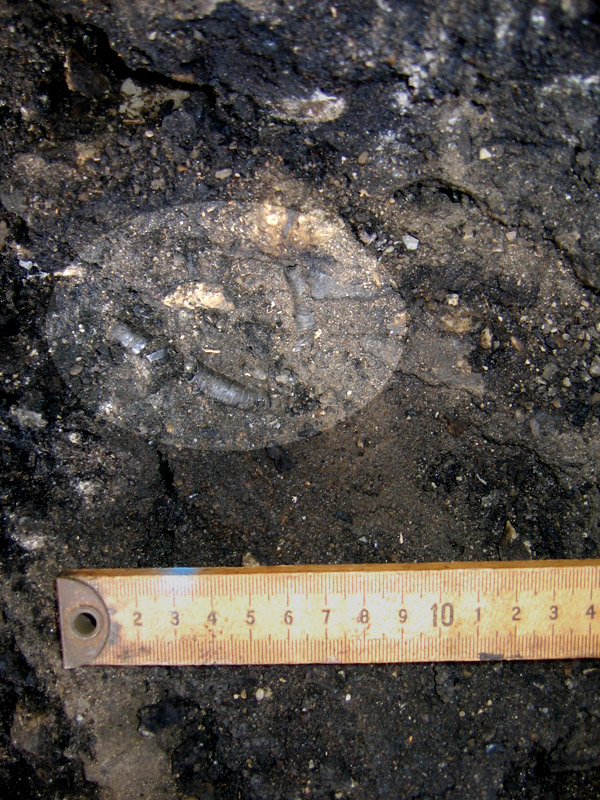
Millipedes! Or centipedes! Or maybe decapedes! A-lot-of-pedes! Whatever -- something that USED to have a lot of feet, but doesn't anymore and therefore CANNOT CRAWL all over me when I'm digging. In the particular grid that I'm working in, (C-2/L2 for those keeping score), there's a thin layer of green clay in between two layers of asphaltic sand, which is filled with compressed plant parts -- complete leaves in some cases, as Ryan found a few weeks ago -- and tons of insect/arthropod/etc remains all around. It looks like this:

Well, it more or less looks like this. Pretend that our digital camera doesn't get all washed out when it tries to photograph anything remotely black.
Per our boss, Collections Manager Christopher A. Shaw, this seam of green clay may be a layer of oak leaf litter -- thus, Deposit 1 was once surrounded by a grove of oak trees.
Meanwhile, on Deposit 10A, excavation marches on! We had another near-death experience last week, when we found what looked suspiciously like naturally occurring asbestos. Fortunately, we were totally wrong -- it's nothing but Epsom salt, and we are panicky excavators. So, here's to not getting mesothelioma!
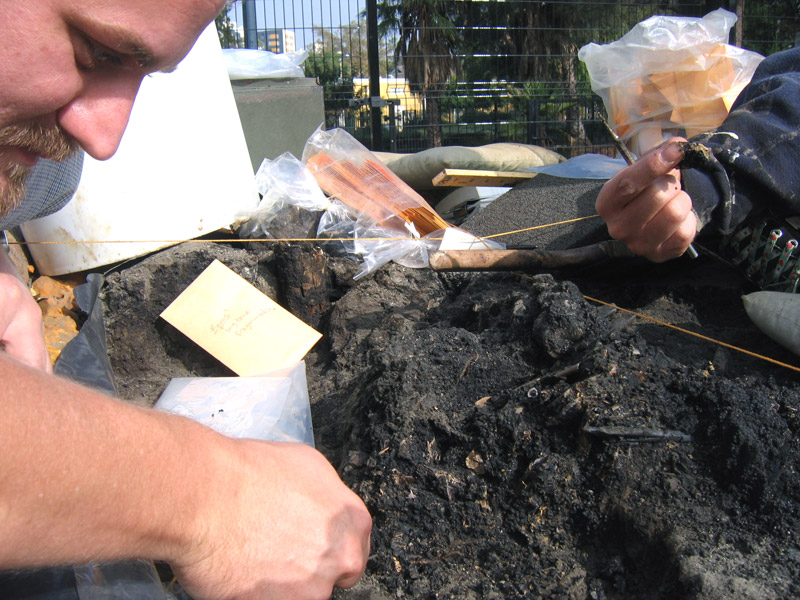 yay! not dying!
 We're only about 20cm below the original surface of Deposit 10A. But so far we've found several pieces of tortoise shell -- almost unheard of at Rancho La Brea until now -- and a near complete pond turtle shell.
21 November 2008
update, of the weekly variety
 it's Photo Collage Madness 2008! Click through to our flickr.com page for highlights and more photos.
Gallivanting in Mexico aside, paleontology marches on here at Rancho La Brea. The grid that had been giving us so much trouble two weeks ago has met its match, and its demise:
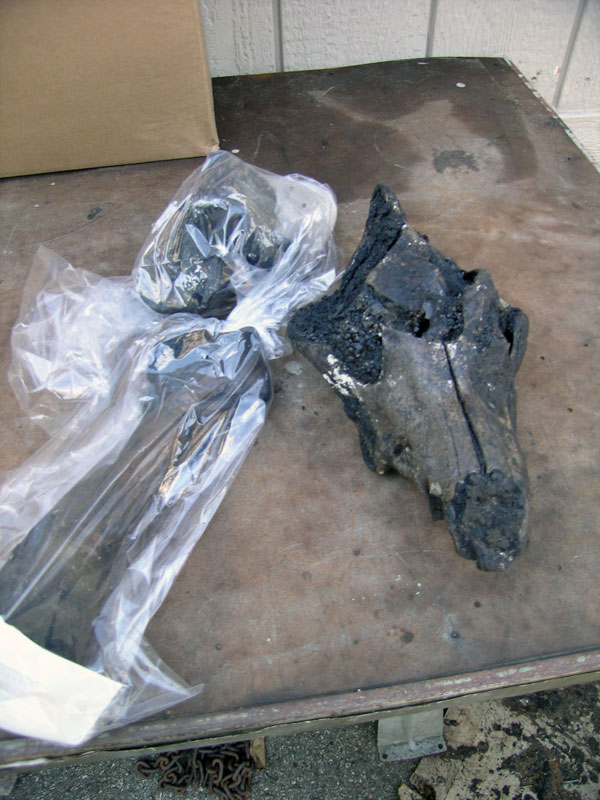 l to r: Saber-toothed cat humerus, giant ground sloth vertebra, dire wolf skull.
The dire wolf skull had been upside-down in the grid; once we got it out and flipped it over, we discovered that it was heavily grooved and pitted as a result of pit wear. Or, in other words: there's a hole in his head! Observe:
In other news:
-we've measured out approximately 34 bones since Oct 31st.
-we just opened a new deposit: number 10A. Photos forthcoming.
-we've made a great deal of progress in our mapping -- the entire surface of deposit 1 has been sketched and stitched together. Again, photos forthcoming.
17 November 2008
Note from the Lone Male Excavator
Hi all. I'm still here, treading in a sea of tar and estrogen.
In an attempt to be more like Andie, I've decided to put up another post and to start reading occasional comic graphic novels instead of just paleomammalogy and Harry Potter books, as has become the habit. I found this graphic novel of the first 10 comics of "Y, The Last Man" about this guy who ends up being the last man on Earth after all the rest die from something (don't know yet what, but I think it must be something to do with an attack on some phenotype from the Y chromosome, eh?).
Anyway, this guy is left alone in a world full of women, so I thought the series highly appropriate for me. We'll see.
Anyway, pulled this juvenile Smilodon vertebra out the other day (see pic). It is a very confused vertebra; it does not know whether it's an individual vertebra or part of the sacrum. This is a sort of developmental disorder likely caused by genetic problems and not uncommon in Smilodon.  You can see (compared to the adult normal vertebra in the pic) that one side of the bone thinks it is a normal vertebra and the other thinks it is part of the sacrum. Furthermore, the neural spine is both off-center and angled wierd. I thought this one was pretty neato, but Michelle is the excavator, excuse me, excavatrix, who is really into pathologies.
You can see (compared to the adult normal vertebra in the pic) that one side of the bone thinks it is a normal vertebra and the other thinks it is part of the sacrum. Furthermore, the neural spine is both off-center and angled wierd. I thought this one was pretty neato, but Michelle is the excavator, excuse me, excavatrix, who is really into pathologies.This is one of the sweet perks to having such a large collection/set of deposits like Rancho La Brea: not only do we get a clear picture of the complete skeletal morphology of members of our fauna, but we get a very good knowledge of the pathologies which affected them.
Also see below the complete leaf I uncovered yesterday!
.jpg)
14 November 2008
the-past-two-weeksly update: no news is good news
No weekly update last week because we were in beautiful El Golfo de Santa Clara in Sonora, Mexico collecting fossils! We camped in the desert for five days; collected numerous ice age (but older than RLB) fossils; watched many beautiful sunsets; and returned home to the rather sobering realization that excavating at the La Brea Tar Pits for one day leaves one even grimier than camping in the desert (without showering!) for five. Gross, right? Anyway...
This is El Golfo:
And this is us:
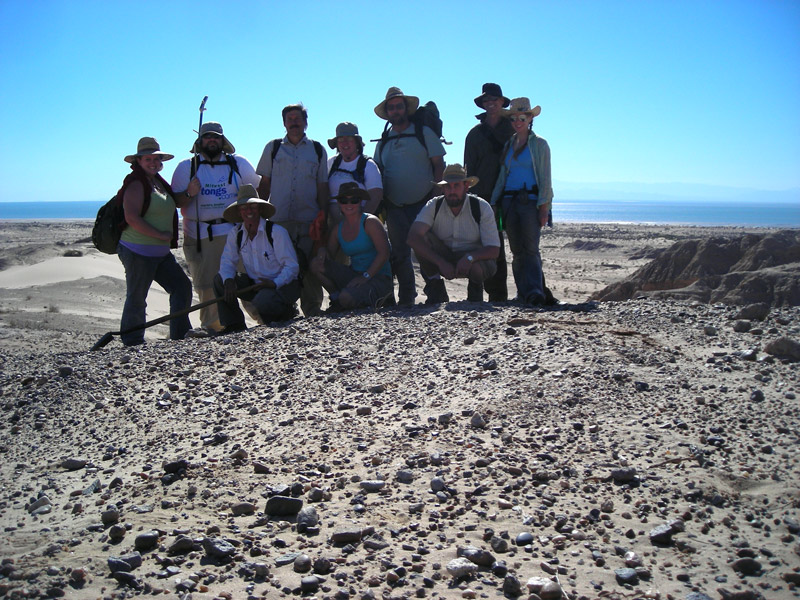
From left to right, standing: Laura Tewksbury, Trevor Valle, Robert Predmore, Melody Weaver, Chris Shaw, Michael Wilson, Andie Thomer. Kneeling: Fred Croxen, Aisling Farrell, Ryan Long
El Golfo de Santa Clara is a magical land, where cars glide along the ocean:

And boats wind up on the street:
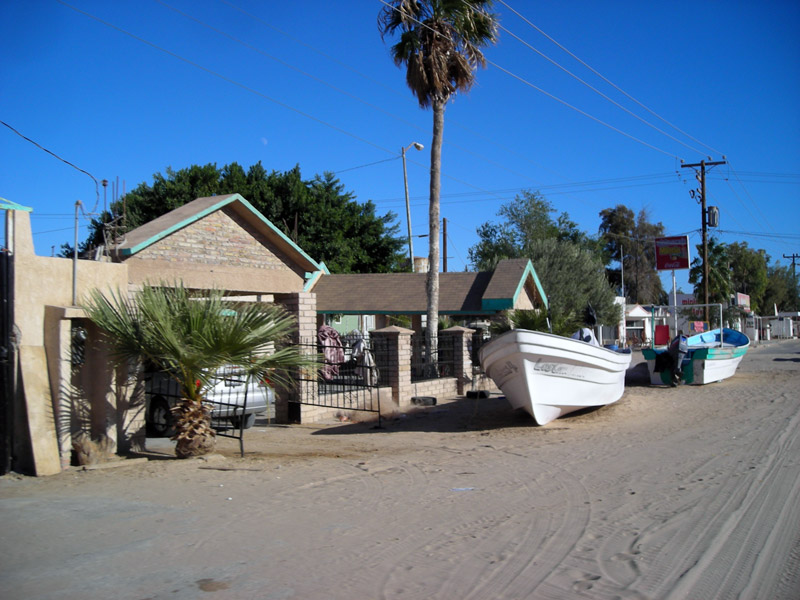
And fossils are NOT in tar pits! Oh no! They are lying on the ground, for everyone to see! See all the little rocks in the picture below?
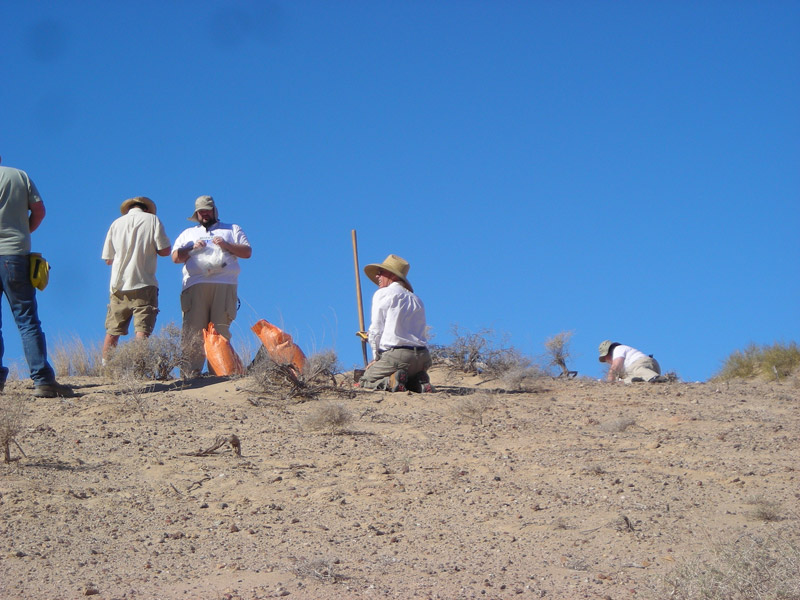
A good number of those are actually very small fossils. Geologist Fred Croxen (in the center, with the jaunty hat) is bagging up rocks and dirt from the surface, which will then be sifted through in mesh screens:
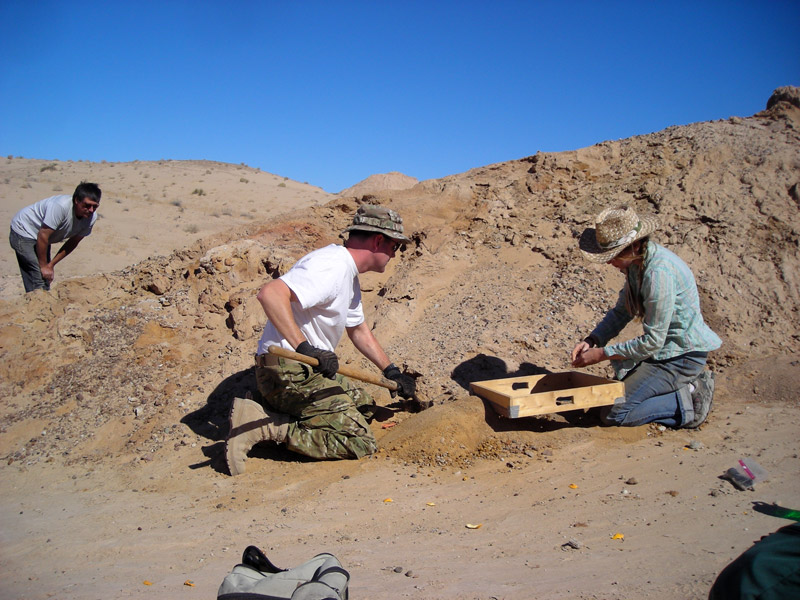
and eventually sorted through under a microscope for the same kinds of microfossils that we find here at Rancho La Brea. The fossils from El Golfo are considerably older than those here -- 1 to 1.5 million years old, compared to our measly 10 to 40 thousand -- but nevertheless contain many similar species as our tar pits.
More soon!
03 November 2008
view from the top
Over the weekend, I put together a faux-panorama of the top of Deposit 1. Standing in the northwestern corner of the deposit, I did my very best David Hockney impression and photographed everything I could see from there, and then overlaid the images in Photoshop. Though its not nearly as helpful as a wide-angle photograph would have been, I think this still gives a good idea of what the overall deposit looks like. The fossiliferous grids are (so far) all in the eastern portion of the box; most other grids are sterile (no fossils). If you click on the image above, you'll be taken to our page on flickr.com (where we store all the photos featured on this blog, as well as many others), where you can mouse-over different parts of the photo to read descriptive notes.

Subscribe to:
Posts (Atom)

 Posts
Posts


