14 November 2008

the-past-two-weeksly update: no news is good news

No weekly update last week because we were in beautiful El Golfo de Santa Clara in Sonora, Mexico collecting fossils! We camped in the desert for five days; collected numerous ice age (but older than RLB) fossils; watched many beautiful sunsets; and returned home to the rather sobering realization that excavating at the La Brea Tar Pits for one day leaves one even grimier than camping in the desert (without showering!) for five. Gross, right? Anyway...

This is El Golfo:


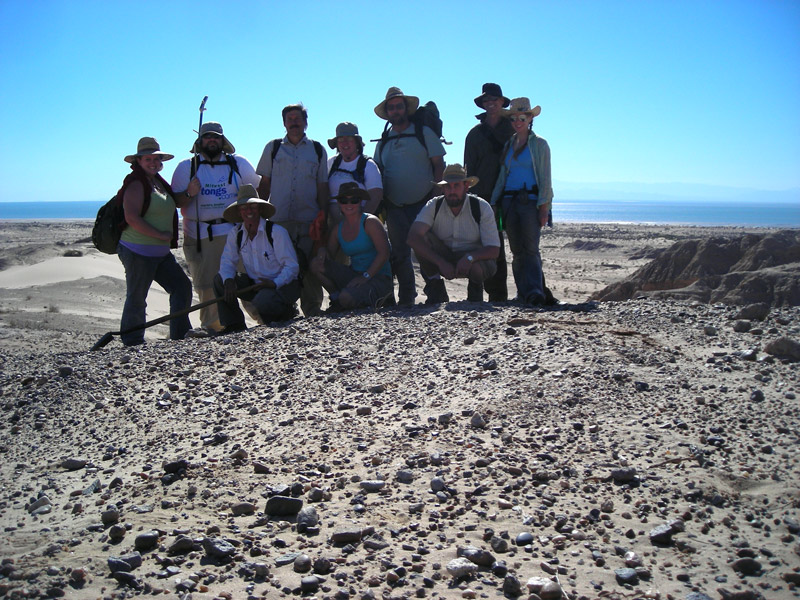
And this is us:

From left to right, standing: Laura Tewksbury, Trevor Valle, Robert Predmore, Melody Weaver, Chris Shaw, Michael Wilson, Andie Thomer. Kneeling: Fred Croxen, Aisling Farrell, Ryan Long

El Golfo de Santa Clara is a magical land, where cars glide along the ocean:


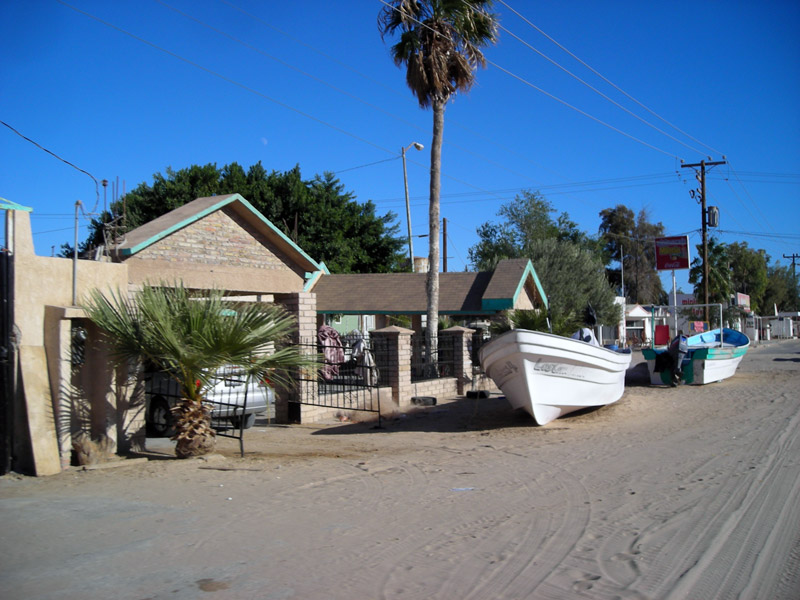
And boats wind up on the street:


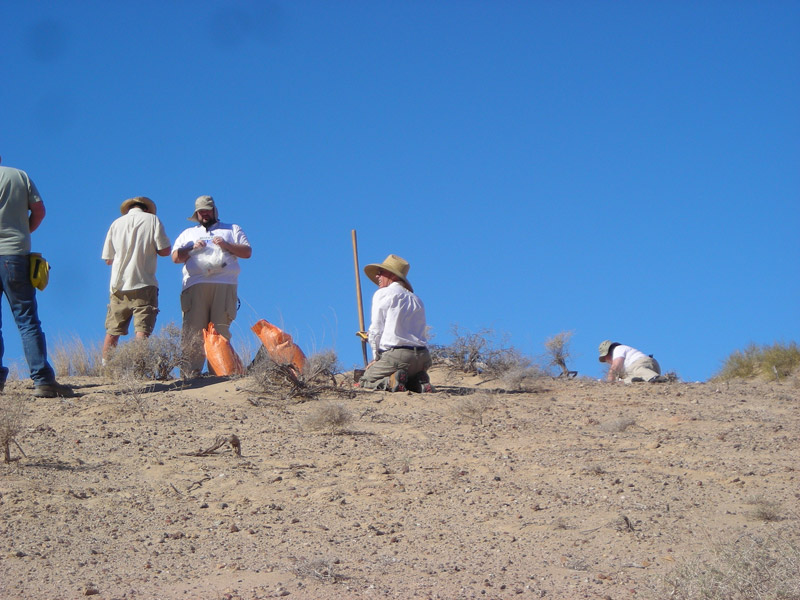
And fossils are NOT in tar pits! Oh no! They are lying on the ground, for everyone to see! See all the little rocks in the picture below?


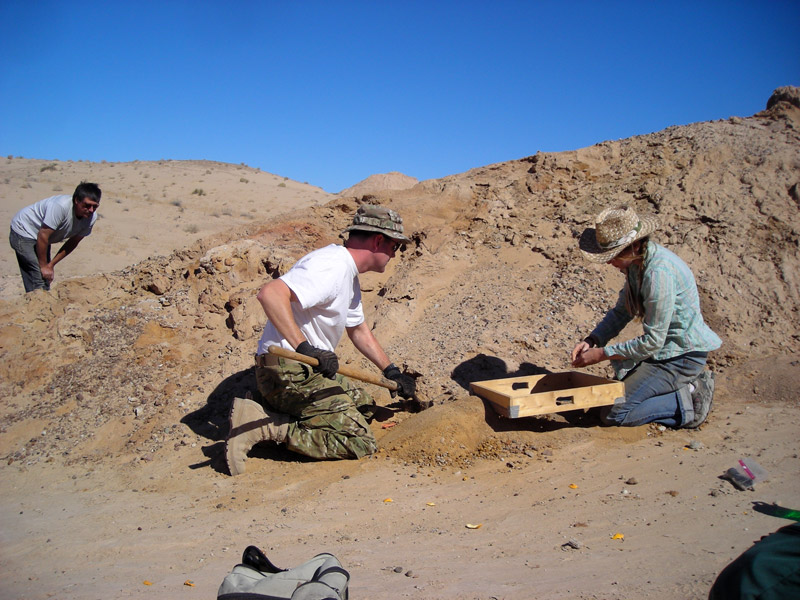
A good number of those are actually very small fossils. Geologist Fred Croxen (in the center, with the jaunty hat) is bagging up rocks and dirt from the surface, which will then be sifted through in mesh screens:


and eventually sorted through under a microscope for the same kinds of microfossils that we find here at Rancho La Brea. The fossils from El Golfo are considerably older than those here -- 1 to 1.5 million years old, compared to our measly 10 to 40 thousand -- but nevertheless contain many similar species as our tar pits.

More soon!

03 November 2008

view from the top


Over the weekend, I put together a faux-panorama of the top of Deposit 1. Standing in the northwestern corner of the deposit, I did my very best David Hockney impression and photographed everything I could see from there, and then overlaid the images in Photoshop. Though its not nearly as helpful as a wide-angle photograph would have been, I think this still gives a good idea of what the overall deposit looks like. The fossiliferous grids are (so far) all in the eastern portion of the box; most other grids are sterile (no fossils). If you click on the image above, you'll be taken to our page on flickr.com (where we store all the photos featured on this blog, as well as many others), where you can mouse-over different parts of the photo to read descriptive notes.

31 October 2008

weekly update: happy halloween!

We here at Rancho La Brea pride ourselves on our holiday spirit.

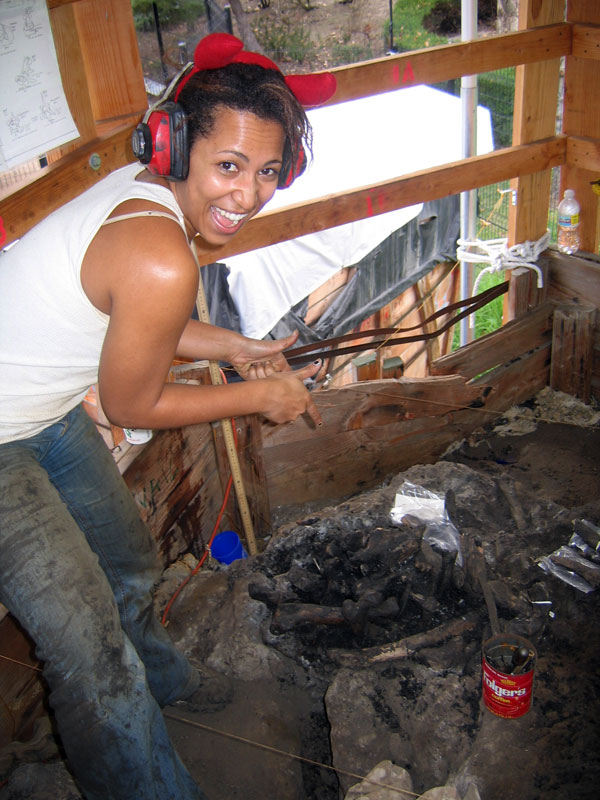
Michelle. Devilish excavatrix extraordinaire.

Unfortunately, Michelle took her Halloween persona a little too seriously today, and placed a hex on grid B-1.

The face (and index fingers) of evil.

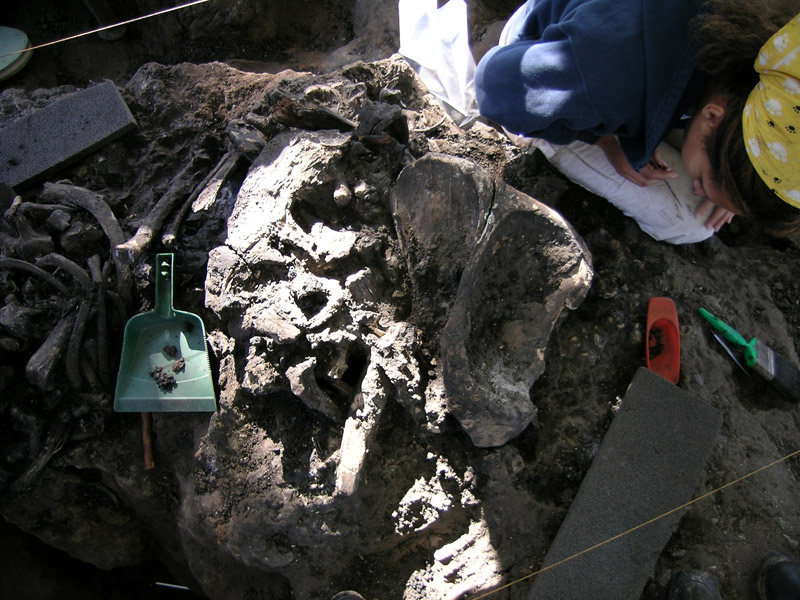
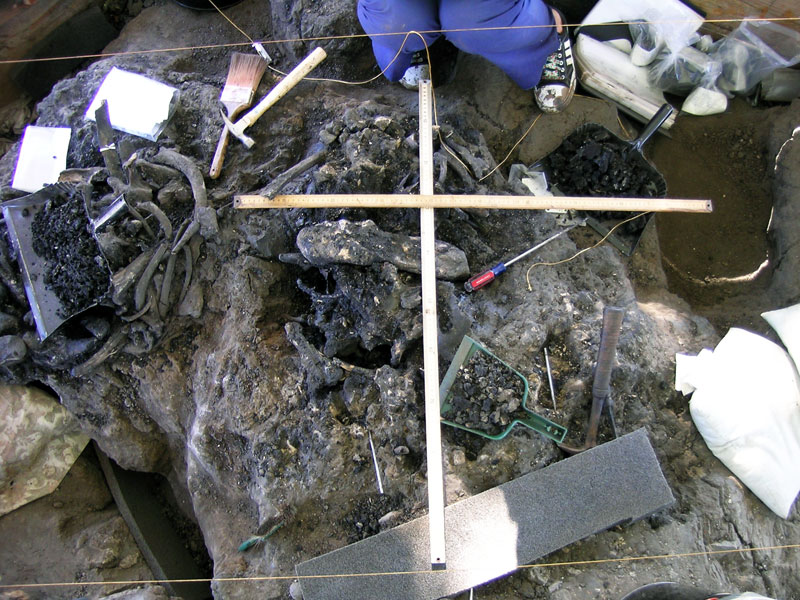
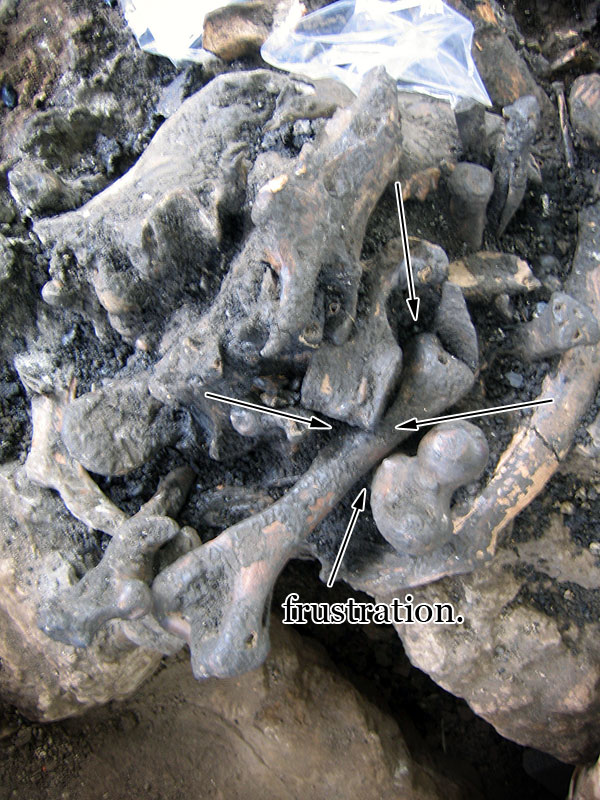
Because ever since SHE worked in B-1 yesterday, we've come to a near standstill in fossil extraction. All of the bones are intertwined with one another, and completely STUCK in place. The big dire wolf skull is stuck on top of the lion skull, and the sloth vertebra is stuck next to the dire wolf skull, and the saber-toothed cat humerus is pinning the vertebra in place, etc etc etc. It is a veritable portrait of frustration. Observe:


VERITABLE, I say!

Curse you, devilish Michelle! And curse you B-1!

This week's tally:
-33 bones extracted, including that juvenile saber-toothed cat skull fragment:

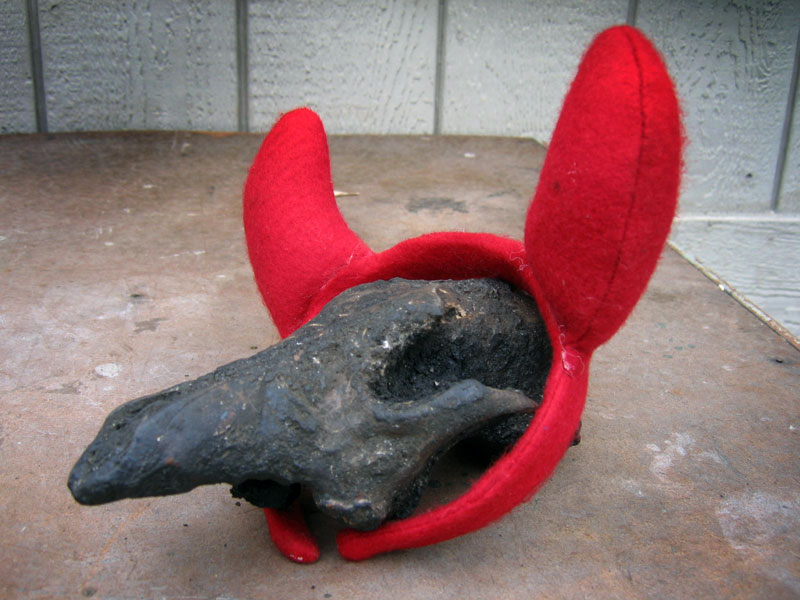
Shelley's Halloween costume: hand model!

At first, we thought we'd broken the saber during excavation, but after closer inspection, it looks like the hole in the center of the tooth is the natural result of pit wear -- the erosion of bones caused by other bones as they all jostle around in the tar pit.

- We also got the second-to-last dire wolf skull out:

Photo by Michelle.

Happy Halloween!

28 October 2008

weekly update: dogs and cats, living together, mass hysteria!

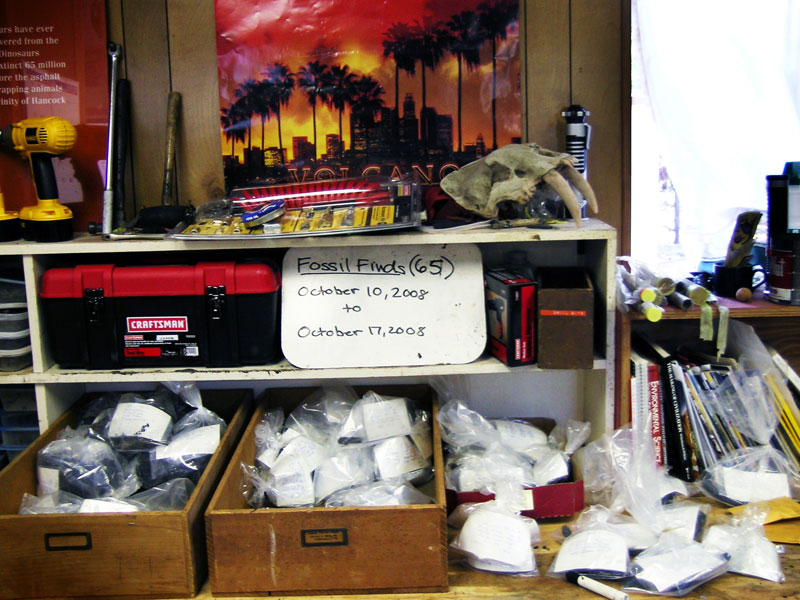
Yeah, it's messy, but does your office have lightsabers and power tools on the same shelf?

We're gonna try to make this weekly update thing happen, like, every week. On Fridays. But not this past Friday, because Blogger ate my last update before it posted properly (curse you, Google...). Thus, we're a little behind, so this is more of a The-Past-Two-or-Three-Weeks update.

So, The Past-Two-or-Three-Weeksly tally:
- 120 bones measured out between Oct 10 - 24

notable finds:
- the coracoid of a Teratornis merriami (Merriam's teratorn). Teratorn's were huge birds of prey; their name means "monster bird" in Greek; they had a 13' wingspan; and they looked kind of like gigantic condor-vulture hybrids.
- the radius of a Capromeryx (dwarf pronghorn)
- again, a whole grip of ribs from a whole bunch of animals, all laying on top of each other. Excavating them has been like playing pick-up sticks in a graveyard, but we finally got at least a dozen out of the way, including three complete vertebral (as opposed to sternal) ribs.
- several Giant Ground Sloth caudal (tail) vertebrae and haemal arches (mini-psuedo-vertebrae that articulate with the underside of caudal verterbae)
- the semi-complete underside of a turtle shell. This was found in a section of the deposit that we previously thought was sterile, which is very, very good news -- more bones means less boring fossil-less dirt to dig through.
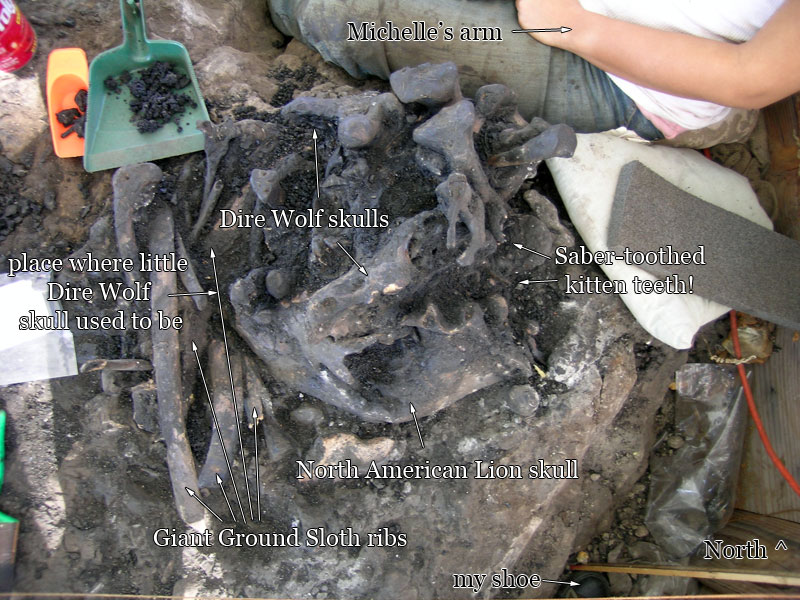
- Dogs and cats are peacefully co-habitating in grid B-1; we've found 3 dire wolf skulls so far (2 are pictured below), various bones from at least 2 coyotes, various bones from at least 2 saber-toothed cats, and as Ryan previously posted, the skull of a North American lion has been uncovered, but not yet excavated.

Grid B-1, Level 2, as of October 24, 2008

One of the dire wolf skulls (from a particularly old individual -- his teeth are worn down almost to the root) is directly on top of the lion skull.


highlight of the north american lion skull. mouse-over for the highlight of the dire wolf (if the image doesn't immediately shift, wait a few moments for it to load, and try again).

- as I previously posted, the saber of a saber-toothed kitten has been exposed.

look!


As you can see, saber-toothed cats were born with little sabers, which makes one particularly pity the saber-toothed mothers...

notable events:
- After months of excavation, Kristen got the giant ground sloth scapulas out!!


and grid B-2 has gone from this:


to this:


That's a giant ground sloth ulna in the center. Eventually, I hope to plot the location of all sloth bones in Deposit 1 to get a better idea of how, exactly, the animal's skeleton fell apart.

Once again: progress!

18 October 2008

today...

we found two saber-toothed KITTEN sabers! completely amazing. pictures forthcoming. wait, with bated breath, you shall....

16 October 2008

Note from the Lone Male Excavator:

I have often been asked what it is like to work as the lone man among four women. I usually reply in one of two ways. On a good day I say, "It is awesome to work with four talented, intelligent, beautiful, tough women." On a day when I am forced to watch The View and/or Oprah during break times I say, "There are good days and bad days." In essence each of my responses is true, but overall, I work with four people that know, as I do, that we have one of the coolest jobs on Earth. Though our tight-knit group is a socially intense and complex small band of hominins, it is this author's opinion that intragroup cooperation is facilitated quite readily by the composition of individuals and the male to female ratio.

Now, I'm sure you've heard enough on that matter for this post, and even if you have not, too bad, because I have something far more interesting to discuss:
We have partially uncovered the skull of a North American "Lion" (Panthera atrox). I'm sure that pictures will be posted of this find as we make more progress in removing the bones still above it and, finaly the skull itself. From what we have seen so far it is at least fairly well preserved. As was noted in an earlier post, we have also found a P. atrox pelvis. The skull was found in the same grid only a few inches below. We are curious as to how many of the many ribs and vertebrae and other bones found in this grid might also be attributable to P. atrox. Many of the bones in this grid have been of Smilodon [including a complete saber (upper canine)] and it is not always easy to determine an identification of the more general bones until they have been cleaned in the lab.

Well (2!), until next time...

15 October 2008

measure for measure

Earlier this week, we measured out the left half of an American Lion pelvis (or, more anatomically correctly, an innominate). Whilst typing this into yesterday's entry, I realized I've never actually explained what "measuring" a fossil entails, let alone why we do it.

"Measuring out" a fossil means recording the location of two to three of the bone's anatomical points (usually three) within the context of a 1m x 1m x 25cm grid. For instance, take our most recent innominate:


The three dots and abbreviations above represent the three different anatomical points: IC stands for Illiac Crest; PT means Pubic Tubercle, and DP means Dorsal Posterior (which isn't actually a point -- it's a general orientation. This portion of the bone is broken off, so there isn't an actual feature to measure. Instead, we measure an arbitrary point, and name it after the point's location in the body: Dorsal, or toward the spine, and Posterior, or toward the rear end).

Each of these three points gets three pieces of data of their very own: measurements of the fossil's location below the original surface of the deposit (abbreviated as "BD" for "Below Datum"), north of the southern most line of the grid (N), and west of the easternmost line of the grid (W). These measurements are written into our field notes, and carbon copied (literally, with little blue pieces of carbon paper) onto 3" x 5" cards. Confused yet? Fear not, it sounds much more complicated than it actually is. But here's an enhanced version of the final product:


Remember Algebra class waaaay back in 9th grade? Wait, let me rephrase that -- remember any of the math from Algebra class waaaay back in 9th grade? Yeah, me neither. However, had you paid closer attention to the graphing portion of your text (and less attention to Spitball Trajectory 101), you would recognize those three columns of numbers as coordinates within a 3-dimensional graph. For example, for the IC, x = 43, y = 42, z = 32.5, etc. By recording all of these coordinates, we're able to later reconstruct the fossil's position within the deposit. And in doing that, we can learn all sorts of nifty things about how skeletons fall apart within a tar pit, or which animal got trapped first, or how asphaltic sand shifts underground over time, and so on and so forth.

A better photo narrative of a fossil's journey from grubby, dirt-covered groundling to a finished, fully prepared specimen is forthcoming, but until then, I hope this has been helpful. Or, at the very least, has inspired you all to pay closer attention in Algebra II.

14 October 2008

this week in urban paleontology

Busy, busy excavators we have been!


The photo above shows the 50+ fossils we've measured out over the last two weeks. Extremely note-worthy finds include:
- a metacarpal (hand bone) of a Capromeryx (an extinct and fairly rare species of dwarf pronghorn)
- numerous saber-toothed cat and dire wolf ribs
- at least 6 sub-adult thoracic vertebrae (vertebrae from the rib cage) of a saber-toothed cat. We think they're all from the same individual animal! They were all found in the same 50cm X 50cm x 25cm area of the fossil deposit, and all appear to be about the same age. This is the sort of semi-articulation or association that we've been so excited about finding, because we very rarely (if ever) find it in Pit 91.
- part of a dire wolf skull
- at least four coyote jaw pieces
- a sloth sternal rib (a rib from the front of the ribcage, rather than the back. If you can't find one in your own torso, don't worry -- humans do not have sternal ribs. If you do find one in your own ribcage, please let us know! We'd be extremely interested in studying you...)
- the astragalus (an ankle bone, AKA the talus in humans), scapula, and pelvis (pictured below) of an American Lion

the measured pelvis, in it's natural environment: a metal bucket and a plastic bag. more on this tomorrow

What does this mean? Well, we've found not just one, but TWO of Rancho La Brea's rarer species (the American Lion and the Dwarf Pronghorn) in our first month of digging, not to mention another unique instance of fossil association! This first deposit is already adding to our knowledge base, and these discoveries bode well for the rest our excavation.

And remember this?

(l to r: sloth left scapula, sloth right scapula, ryan)

it now looks like this:

(l to r: dustpan, sloth left scapula, yet another tibia, sloth rib, sloth right scapula, michelle)

Progress!

28 September 2008

update!

Long time, no update, but with good reason: we finally officially "opened" our first fossiliferous grid in our first fossil box from Project 23, and we've been too busy digging to blog. Hopefully, some pictures will make up for the thousand or so words we have not written.

Below, a view of B-1 circa a few weeks ago:


roll-over for highlight

The three highlighted bones above are all tibias, and are all from the right leg. However, they're from three separate animals:

From left to right, you're looking at lower right hind leg bones of a coyote, a dire wolf, and a young saber-toothed cat.


We finally got the saber-toothed cat pelvis off the top of the grid:
Note the pelvis-shaped impression in the ground to the left.


Volunteer-of-the-Century Harry made us a brand new tool box:

which now holds our brand new phone, our brand new field notebooks, our brand new meter sticks, our really-old-but-still-totally-useful comparative collection of dire wolf and saber-toothed cat carpals and tarsals (wrist and ankle bones), and, apparently, my three-hour-old cup of coffee.


And speaking of volunteers, we've started bringing them up to help us dig! Tara-the-ever-persistent, of course, was our first:


And finally, we put together a small exhibit for the museum explaining how Project 23 came to be:

The two ribs on the left of the case are from our semi-articulated mammoth; the rib on top is normal, but the rib on the bottom has a large bump in the middle from a break that healed during the mammoth's lifetime. Zed (as the mammoth has been dubbed by lab supervisor Shelley Cox) has several broken-and-re-healed ribs on his right side; he must have sustained a massive injury which he subsequently recovered rather nicely from. And the fossil block on the right is the same block of skulls that came from the "blob" we wrote about last month. The brown vertebra in the middle is from Zed; the white vertebra above it is from Jenny:

Shelley borrowed an Asian elephant skeleton from the Natural History Museum and has been using it to help identify Zed's (much larger, but still comparable) elements. In the photo above, Shelley is comparing Zed's ribs to Jenny's (Zed's are La Brea brown; Jenny's are white).


More soon!

16 September 2008

databasing

One of the most frequently asked questions we get here at the La Brea Tar Pits is one so deceptively simple sounding that it regularly stumps us out of sheer, monosyllabic force. It's not that we don't have an answer -- it's just that the answer is exponentially longer and more complicated than the question.

That question, of course, is "Why?" Why, with a collection of more than 3.5 million fossils, do we keep digging? Don't we have enough fossils? Do we really expect to find anything new?

Some of the answers to these questions, in reverse order, are:

1) We find something new every week, if not every day. Not a new species necessarily, but things like a new and uniquely laid out deposit of fossils (such as our two associated sloth scapulae), or new information on the geology of the deposit. Mini-discoveries like these help color our continually evolving picture of the Pleistocene in Los Angeles. Now, new species are difficult to come by, but with this new project, we have sheer volume on our side. With the amount of fossiliferous dirt we have to dig through, we'd be surprised if we didn't discover a new type of animal.

2) You can never have enough fossils.

3) Now, the big question -- the big "WHY?" There are far more answers to this question than we could possibly cover in one meager blog entry, and many of which we hope to touch on in coming months. As for now, you'll have to settle for this lovely and informative graphic put together by one of our most dedicated volunteers, Tara Thara:


Click on the diagram above to be taken to Many Eyes website, where you can play with the image a bit more extensively. Currently, we're looking at the age of individual vertebrae organized by taxon; if you click through to Many Eyes, you can change that to compare, say, age by depth, or taxon by grid, etc etc.

Man, computers are great. One of the many many reasons we have to keep digging is because with statistical comparisons like the bubble diagram above (created from our Pit 91 Vertebrae Database), the more data, the better. In this chart, we're using the ontogenetic age (the developmental age of the bone) of different vertebrae to generate an estimate of how many very juvenile, juvenile, sub-adult, and fully adult animals we have in Pit 91. And from that information, we can make inferences about the animals' behavior in life. For instance, the large number of sub-adult saber-toothed cats found at Rancho La Brea has led some (such as my boss, Chris Shaw) to believe that Smilodon was a social animal -- the young cats would have gone after a trapped herbivore in the tar pits with their fully grown relatives, and all gotten stuck at the same time.

Now, the caveat to this -- the idea that more data creates more reliable statistics -- is that the dataset must be somewhat complete. Pit 91 hasn't been totally excavated yet -- we've got another 3-8 feet of asphalt to dig through, which equals tens of thousands of more fossils to find -- and we won't be able to make any final conclusions until we're done. On top of this, the database itself isn't complete; again, we have thousands of fossils that have been excavated and identified, but still need their data entered into the computer. However, with Project 23, we're hoping to enter the information into a computerized database as we dig. And since we'll be digging year-round with a much larger staff (as opposed to 12 weeks in the summer with a staff of two) we'll be able keep on top of data entry, and we'll be able to finish excavating each deposit in a much timelier fashion (i.e. under than 30 years).

So that, readers, is one of many reasons why we must keep digging. Population studies demand more data! Databases demand more data entry! And basic human curiosity demands that we slowly, steadily, someday reach the bottom of our inverted Everest.