Volunteer Anna Lopez planted milkweed adjacent to the Pit 91 viewing station to entice monarch butterflies. It has been fascinating and refreshing for us to observe the life cycle of animals that are not dead:


24 February 2010
Monarchs at Pit 91


21 February 2010
we're back!
Friends, I am torn, because on the one hand, I feel extremely bad for not posting for two months, but on the other hand, it is because we have been busy being amazingly productive paleontologists who do not have time for this new-fangled computer contraption -- we simply have too much dirt, too many bones, too much science. Am I to apologize for progress? I think not. But am I to apologize for poor journalism? Absolutely.
As penance, I humbly offer you easily enough material for three separate posts. Photo heavy, be warned.
 |
| From New Year, New Dirt |
This, as you may or may not remember (it has been a long time, after all) is a rough map of the Project 23 compound (Pit 91 is the square to the south). We've finished 3 boxes (10A, 10B, and 7B, all x'd out), got half-way through another (7A, put on hold until we can better figure out what to do with it), and are still digging away in deposit 1. Deposit 5B is newly opened. 14 is currently slated to go next. For a better sense of scale, here's a photo of the compound from a couple months ago:
And here's a photo from shortly thereafter:
 |
| From New Year, New Dirt |
 |
| From New Year, New Dirt |
Woah! What happened to 5B??? Well I will tell you.
We took the sides off! Deposit 5B's box had warped somewhat treacherously from the get-go; its base was damaged in the move from LACMA to here. Rather than working around unweildy boards, we decided to experiment and take all the sides off at once. We hoped this would allow us to get a look at the deposit's stratigraphy straight away, so we can better anticipate where fossils will and will not be. We also hoped that the deposit wouldn't immediately fall apart...
 |
| From New Year, New Dirt |
 |
| Jack is so proud! From New Year, New Dirt |
As you can see in the photo above, we were fortunately (mostly) right on both counts: after removing all the boards, we were greeted by some really neat looking strata, and the block remained largely intact....
 |
| Pat Simun wins MVV (most valuable volunteer) From New Year, New Dirt |
 |
| If only lasers actually worked this well. From New Year, New Dirt |
As in other deposits we divided this one up into grids, and are excavating one grid "column" at a time, and creating detailed stratigraphic drawings and lots of photos as we go.
So, as I said, one of the benefits of this excavation method is that we are getting a much better idea of the deposit's geology than we otherwise would, because we're looking at so much of it at one time. The contact between the asphalt and the surrounding silts and clays is much more defined than we've seen in the other deposits from Project 23.
And as excavation has progressed, we've found that there are some truly unique and interesting things about this deposit:
 |
| From New Year, New Dirt |
1) there are two very distinct layers of asphalt within 5B-- likely from two different venting/entrapment episodes, and possibly thousands of years apart from one another... or maybe only 10 -- we won't know until we start carbon dating things. You can hopefully see them in the photo below -- one near the top surface of the deposit, and on near the bottom.
2) there is a partially articulated CAMEL (Camelops hesternus) skeleton in the top layer! This is huge -- camels are fairly rare in our collections, and articulated skeletons are rarer still.
So far we've recovered its humerus:
 |
| From New Year, New Dirt |
So far we've recovered its humerus:
 |
| From New Year, New Dirt |
 |
| From New Year, New Dirt |
and about 6-7 thoracic vertebrae:
 |
| Kristen's forearms are awesomely recognizable. From New Year, New Dirt |
That's the camel's skull up top, and a line of four thoracic verts below. Very exciting.
Meanwhile, in deposit 1, we are still digging away:
 |
| From New Year, New Dirt |
As I think I've mentioned before, there are several grids worth of broken bones in very hard sediment -- the dirt is harder than the fossils. It's difficult, slow work. We've started taking them out of large bone masses like this:
 |
| From New Year, New Dirt |
Awful looking, right? However, the strategic breaks made while taking the bone mass out of the ground SHOULD be easier to repair than the accidental ones made while trying to take each individual bone fragment out.
That having been said, after the block has been run through our brand new degreaser...
The bones come out looking great. This particular chunk had three dire wolf metapodials in it -- perhaps all from the same wolf paw:
 |
| From New Year, New Dirt |
 |
| From New Year, New Dirt |
 |
| From New Year, New Dirt |
 |
| From New Year, New Dirt |
 |
| From New Year, New Dirt |
Note how little of that matrix is made up of actual dirt -- by and large it's plant and bone material. We're still working the kinks out of our degreasing system: figuring out how best to operate it, how many people we need to run it, how best to sort through the resulting thousands of microfossils...
 |
| Well, I suppose that's better than a fork... From New Year, New Dirt |
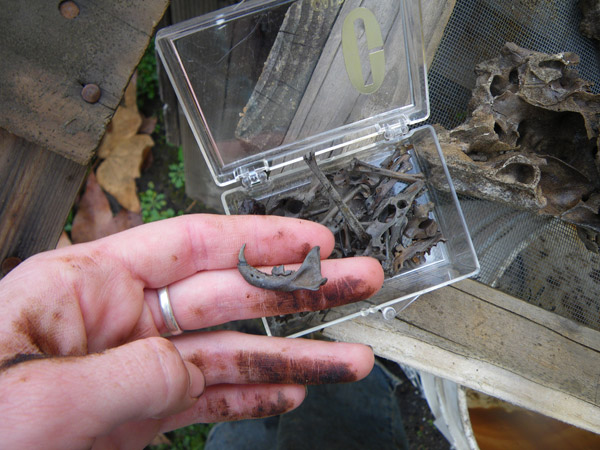
It's frankly overwhelming. We degreased a bucket of bones from the original APRMI salvage of the LACMA parking lot -- it was about 1/4 of the way full, and labeled "spoils" (i.e. not in situ, from pulled out of the ground by a tractor and left off to the side). The results:
 |
| From New Year, New Dirt |
 |
| From New Year, New Dirt |
 |
| From New Year, New Dirt |
several dozen assorted rabbit, rodent, and bird elements...
tarsometatarsi from at least 4 different species of birds...
and last but not least a lizard jaw.
 |
| From New Year, New Dirt |
 |
| From New Year, New Dirt |
And that's just 1 out of 327 spoils buckets, not to mention the who-knows-how-many-hundred matrix buckets scattered throughout the compound...
 |
| From New Year, New Dirt |
So, speaking of working: in the hopes of revitalizing this poor ignored blog, I'm thinking future posts will be faaaar shorter -- like, one photo and a paragraph -- but hopefully far more frequent. That way, you get more posts, and I can spend my Sundays doing Important Weekend Things like cleaning the tar out from my fingernails, getting the tar out from my laundry, and rollerblading (all at the same time? perhaps!), rather than writing about work when I'm not... actually... at... work. Not that I don't love the tar ranch! I just also love Venice Beach.
16 November 2009
update: more sabertoothed cats and kittens
 |
| Solar flares over our pulley. From Back in Dep 1 |
 |
| Volunteers Christina Lutz and Tara Thara. From Back in Dep 1 |
Those are the smiles of happy fossil finders. Why? Because they're actually finding fossils again! Between mostly planty deposit 7A, and really hard and sterile parts of deposit 1, we're been spending entirely too much time digging up dirt rather than fossils. Dirt = not fun. Fossils = awesome. It's very simple.
I've posted many, many pictures of this bone bed before (it's where we found our North American Lion skull and assorted long bones). And it's once again producing some really great feline finds:
 |
| Sabertoothed cat skull! From Back in Dep 1 |
The big dusty skull-looking thing on the bottom is a... big, dusty sabertoothed cat skull, with a complete sabertoothed cat pelvis immediately above it. And look a little above the skull and to the right:
 |
| Smilodon saber in situ. From Back in Dep 1 |
It's a complete sabertoothed cat saber!
 |
| Smilodon saber in one piece! From Back in Dep 1 |
And in the grid directly across from this one, we found 2 more sabertoothed cat kitten sabers:
This may bring our (estimated) minimum number of sabertoothed cats in this deposit to around 7: 3-4 juveniles, 1 sub-adult (teenager) and at least 2 adults (I will have to double check these number with the lab). It's actually possible to match sabers to skulls, by taking casts of the alveolus (tooth socket) and comparing the cast to the tooth! This is something we might want to do in the distant future; because this deposit is so small we may be better able to discern which bones belong to which individual cat -- especially for these 4 "kittens" we've found. Yes, they're all young, but they're not of the exact same age (which makes me think this isn't a singular litter that got stuck). So by determining the age of each young sabertoothed cat bone we find, we can figure out whose limbs are whose, and then perhaps extrapolate from that how much the asphalt has moved/disturbed the skeletons since they first got stuck 10-40 thousand years ago.
She works here now! She likes rocks and photography and is generally great.
 |
| Volunteer Steven Wintergerst holding a Smilodon kitten saber From Back in Dep 1 |
This may bring our (estimated) minimum number of sabertoothed cats in this deposit to around 7: 3-4 juveniles, 1 sub-adult (teenager) and at least 2 adults (I will have to double check these number with the lab). It's actually possible to match sabers to skulls, by taking casts of the alveolus (tooth socket) and comparing the cast to the tooth! This is something we might want to do in the distant future; because this deposit is so small we may be better able to discern which bones belong to which individual cat -- especially for these 4 "kittens" we've found. Yes, they're all young, but they're not of the exact same age (which makes me think this isn't a singular litter that got stuck). So by determining the age of each young sabertoothed cat bone we find, we can figure out whose limbs are whose, and then perhaps extrapolate from that how much the asphalt has moved/disturbed the skeletons since they first got stuck 10-40 thousand years ago.
In non-mammalian news:

2 partial turtle shells have come out of the formerly sterile areas west of the main bone deposit. Turtle shells are made out of a number of interlocking plates, and while the individual plates are extremely common, articulated/associated ones are not -- in fact, these may be the only even semi-complete shells we've ever found at Rancho La Brea. Trevor's been working on them in the lab, and has one of them somewhat reconstructed (which he will hopefully tell you all about at some later date if he ever gets around to making a blog post, hint hint).
FINALLY two other items of business:
1) This is Carrie!
 |
| New excavator Carrie Howard! From Back in Dep 1 |
She works here now! She likes rocks and photography and is generally great.
2) I don't often share links on here, but for those who are interested in science education in America and the general fight to keep evolutionary biology from being grievously misunderstood may find http://www.dontdissdarwin.com/ helpful.
Next post: so, what's in that barn-looking building next to the trailer?
 |
| Greg A. hunts for lunch by Pit 10 From Back in Dep 1 |
No, it is not dinosaur! It is a degreaser, which is far more useful and hopefully far less dangerous! More later.
17 October 2009
update: out of 7A, back in to deposit 1
 |
| they escaped from the tar pits, but not from each other: these two dragonflies were found flying around together, attached at the hip by asphalt. Michelle kindly helped free them. From 7A and back into 1 |
Right. So we've been working steadily in deposit 7A, and are about 1/2 a meter down in all areas. There were three bones immediately visible on the surface (all sliced by the tractor that found them, and horribly dried out), but other than that we've yet to find any substantial vertebrate fossil deposit. We've found a few scattered pieces of turtle shell (not to mention some extremely odd fragments of mineralized bone -- very rare for Rancho la Brea!) but none of the big jumbly bone masses we've come to know and love. What we have found:
 |
| Shells shells shells! From 7A and back into 1 |
 |
| excavator hand for scale, From 7A and back into 1 |
These freshwater snail shells are further contextualized by the immense amount of plant material we've been getting out of the deposit as well; the northeastern corner of the deposit is filled with what appear to be tree branches (but possibly roots). Additionally, there's some interesting stratigraphy going on in this deposit: layers of river sand and large rounded rocks.
But as of yet no big vertebrate fossils. Boo.
For that reason (and because we're acutely aware we're already one year into a five year project!), we've put deposit 7A on hold, and re-doubled our efforts in deposit 1 (the big box we first started in).
 |
| That's usin' your head, Russ. From 7A and back into 1 |
And we've made some really impressive progress! But more on that next post. Until then, I leave you with this month's "What is it?" Check out the photo below, and leave a comment with your guess of species and element! Correct guesses win a congratulatory shout out on the next post, and the knowledge that they have bettered their internet peers!
 |
| I'll give you a hint: it's a fossil. From What is it? |
01 October 2009
what we did over our summer vacation:
 |
| The scarab beetle in our compost pile says hello From End of 7B, Beginning of 7A |
Well, not a vacation from digging -- just a vacation from blogging. Apologies to all, and regular updates will commence henceforth. SO:
 |
| Nola hammers the lid on the last matrix bucket from deposit 7B From End of 7B, Beginning of 7A |
We finished excavating deposit 7B in early August. Final tally of things found is still pending, but all in all, it was rather pleasantly fossiliferous. Some of the cooler finds include a number of potentially associated bison bones (the bison itself has been named James K. Polk), a mostly complete sabertoothed cat skull (named Bixby) (I will have to explain our naming conventions in a later post...), several unusually large sabertoothed cat limb bones that might belong to Bixby, several rattlesnake vertebrae, a gopher skull, the usual slew of dire wolf bones, and lots and lots of tree branches (tentatively ID'd as manzanita). And nicely enough, 7B continued to produce bones down to its final few layers:
 |
| Sabertoothed cat cervical vertebra From End of 7B, Beginning of 7A |
This sabertoothed cat vertebra was found at the very bottom of the deposit. As you can see, the right-hand side of the vert was sheared off in the process of putting a bottom on the box -- no good! Ah well -- such is paleo-salvage. Of the 327 buckets recovered from the LACMA site, a substantial number were labeled "Deposit 7." Someday (hopefully sooner rather than later), we will degrease the buckets and try to find this vertebra's missing half, but for now, we best be moving on...
 |
| Deposit 7A From End of 7B, Beginning of 7A |
...to deposit 7A! 7A's a bit bigger than 7B, so we built this nifty railing to keep us from plummeting to our deaths (or, more likely, tumbling to a sprained ankle, but whatever, SAFETY FIRST dang it), and we've got some strategically placed Little Giant ladders around to help us in and out. But check out that silver thing on the side:
 |
| it's like a slide for matrix! wheee! From End of 7B, Beginning of 7A |
Rather than breaking our backs hauling buckets in and out of the box, Michelle came up with the great idea of leaving the buckets on the ground, and using a make-shift funnel to pour the matrix in. GENIUS! And I can't believe we didn't think of it earlier. It's not about working harder -- it's about working smarter.
After finding deposit 7B fossiliferous to the very end, we had high hopes for 7A, but were (understandably, I think) a bit disappointed to find only this dehydrated mess greeting us on the deposit's surface:
 |
| that chalky stuff in the center is bone. ugh. From End of 7B, Beginning of 7A |
Blech. Nevertheless, we soldier on! We've been working on Deposit 7A for about 2 months now, and we have found a few specimens, here and there...
 |
| Laura finds a specimen here, a specimen there... From End of 7B, Beginning of 7A |
04 September 2009
Boo!
This is The Ghost of the Lone Male Excavator! I just wanted to drop in and announce that I have nothing paleontological to report. Also, I await the next blog post from Andrea ...rattle, rattle, rattle...
Aloha.
Subscribe to:
Posts (Atom)

 Posts
Posts

